Navigating your way through creative perfectionism

Navigating your way through creative perfectionism

“You can fail at what you don’t want, so you might as well take a chance on doing what you love.”

– Jim Carrey

One way in which we play-it-safe is by delaying projects, avoiding important tasks or striving for perfection.

​​My guest today is Janis Ozolins, a visual illustrator.

Key Takeaways

In this episode, Janis and I focus on the creative process and perfectionism: what is it? Is perfectionism a bad thing? Is perfectionism an angel? Is striving for perfection a toxic trait? Is it both?

How do we do our best work while navigating self-doubt, criticizing thoughts, and a push to do things right and perfectly?

This conversation isn’t a conversation about productivity per se, but it’s a conversation about how we can be our best creative selves while navigating internal conflicts.

Janis shares how he handles self-doubtful thoughts, perfectionist tendencies, and negative feedback when sharing his illustrations.

You will also hear what drives Janis’s visual work and principles – or constraints – as he calls them – to create his visuals.

perfectionism

Resources

Resources from Dr. Z.

Show notes with time-stamps

00:00 The Perfectionist Monster
00:27 The Origin of the Perfectionist Monster Concept
02:15 Managing Perfectionism in Creative Work
03:40 The Power of External Accountability and Consistency
05:12 Embracing Imperfection and Learning from Experience
08:51 Creating Content with Purpose and Quality
13:18 Balancing Pride and Productivity in Creative Output
16:50 Exploring Creative Constraints and Process
19:40 Unveiling the Creative Process: From Inspiration to Illustration
20:56 The Art of Content Creation: Ideation to Publication
22:52 Evaluating Creative Work: Clarity, Amplification, and Impact
29:49 Navigating Feedback: Embracing Positivity and Dealing with Negativity
34:09 Personal Growth Through Self-Development Books
36:45 Dream Coffee Dates: From Historical Figures to Personal Connections
 

Listen Here

Apple
Spotify

Respond to those urges to overthink with kindness

Respond to those urges to overthink with kindness

Reading Time: 3 minutes

Every time I notice I’m getting into a rabbit hole of thinking, I tell myself, “Here is my worry-maker announcing its arrival..” and then move on with my day, just like nothing has bothered my mind ..” .. just kidding!!!!

When catching a thought that could lead me to an overthinking hole….

  • What If I cannot handle what happens?
  • If that were to happen, I would never be able to be okay with myself
  • I don’t recall exactly what I said, and now I cannot let it go. I need to know what I said.
  • I won’t make it.
  • Can’t stop thinking of the time in which I made a mistake.
  • What – if
  • It’s my responsibility to make sure things go well.
  • If I’m thinking a lot about it, it means it’s important.
  • If I don’t know all options, I cannot move forward with my decision

I noticed a recurring theme: a push to overthink, to dwell, to spend hours and hours solving this thinking problem, and with it, to play-it-safe. Who doesn’t play-it-safe? And yet, all those overthinking strategies – playing-it-safe moves as I call them – can lead us to live in our head while life passes by in front of us.

Not our fault. We’re prone to overthinking by design, because of evolution. But, when going along with those urges, then . . . we are at the mercy of our overthinking patterns.

You can get unstuck from overthinking patterns

So far, you have learned what makes overthinking worse, to recognize the types of overthinking you’re prone to, to watch your mind and its minding, to bring yourself back to the life you’re missing when engaging in overthinking patterns, and to observe those thinking patterns without getting swept away by them.

Those micro-skills help. And, you and I know that making a shift comes with urges to go back to the old behaviors, to the old ways of responding to thinking with more thinking; to the behaviors that have been reinforced hundreds of times.

Treat those urges to overthink with kindness

Acknowledge your urge for overthinking, respond to it with kindness and caring. There are hundreds of definitions of self-compassion; sometimes people think about it like flowers and butterflies. But, putting it simple self-compassion is:

  • Treating yourself with kindness, gentleness, and caring.
  • A real-time decision you make without attachment to any outcome
  • A choice you make to make room for uncomfortable thoughts, feelings, urges, and sensations.

Sometimes people decide to fight those urges to overthink.. and while those thinking responses work for a little bit, it’s a matter of time the mind comes up with another thought that pulls into a rabbit hole of thinking. We’re never going to win our minds by responding to thinking with more thinking.

But recognizing that we’re struggling, that we’re getting stuck with a pull to dwell on our thoughts and live in our head, and respond to those moments of stuckness with caring is much more courageous.

One compassionate action

When noticing the urge to overthink – whether you’re driving, eating a piece of dark chocolate, drinking a glass of scotch, or enjoying a meal with your partner – take a deep breath, adjust your posture, maybe lift up your shoulders, and then tell yourself something along the lines of “I’m struggling right now, this is hard.”

The key to practicing self-compassion is to acknowledge that you are struggling in those moments with a push to jump into overthinking land . . .  and that you make a decision to respond yourself with kindness and with gentleness.  If your mind were to be an overprotective friend of yours – so you don’t make a fool of yourself – how would you respond? Perhaps you will say things like, “easy my friend, let’s go easy with those urges .. I get it, this is hard . . . and let’s just be gentle . . . we don’t need to jump into thinking land right now . . . ”

When you learn to face those urges for overthinking with gentleness, you also learn to move from living in your head to living in the present, because you are not busy any longer, trying to control your mind or responding to thinking with more thinking.

Come back to the life you’re missing

Come back to the life you’re missing

Reading Time: 3 minutes

“How we spend our time is how we spend our days. How we spend our days is how our life goes. How our life goes determines whether we thought it was worth living.”

– Keith Yamashita

When you wake up, your mind starts its own journey. It’s like you’re getting into a car and your mind is the driver. Sometimes it takes you exactly to your destination. Sometimes it drives really fast. Sometimes, you can’t just get out of being lost in the streets of big houses, condominiums, and golf courses in the middle of the city. Sometimes, your mind takes you to the end of a cul-de-sac where you feel all those ruminations, worries, doubts, anticipations and many other acrobatic thinking patterns that occupy your time.

  • Thinking about doing things right and perfectly
  • Thinking about all the good reasons to postpone and delay stuff
  • Thinking about how much certainty you need to move forward
  • Thinking about the worst-case scenarios
  • Thinking about past negative outcomes or past mistakes
  • Thinking about not being good enough in some way
  • Thinking about the different ways to get out of a stressful situation
  • Thinking about how you’re the only responsible person for others’ wellbeing
  • Thinking about how thinking is fundamentally important

Overthinking patterns have this automatic quality, rushing you into feelings of stress, anxiety, loss, or dread. You may get so attached to them that they seem real and push you to do things that create much more pain, such as ejecting you from your present.

Dealing with overthinking partners is like every moment you’re confronted by a “haystack-sized pile of needles.”  Each one of those patterns pushes for your attention, makes you feel in a particular way, and claims to be legitimate. They are all interesting thoughts to have; for example, did I marry the right person? Can’t stop thinking about what happened before, I need to make sense of it; what if I don’t make the right decision? 

But the consequence of all of them is that they take you away from what’s happening in front of you, who is in front of you, and what the experience of that moment is for you.

Bring yourself back to the present

  • Acknowledge the cue to overthink
    Remember an important principle: The first thought on your mind, whatever you do afterward is on you.
    Do your best to notice that cue for overthinking (e.g. did I.. I need.. what-if…).
    Don’t fight it; don’t resist it; don’t respond to it. Just say to yourself “here it is.. “ and then …
  • Connect with your body
    Notice your body posture; notice the positions of your legs; notice your back posture; notice the ebb and flow of your breathing; you can also move your arms a bit to notice their movement.
  • Connect with what’s in front of you
    Notice your surroundings: what’s around you. What do you hear? What do you see? What do you smell?
    Notice who is in front of you: is there someone in front, next to, or behind you? How do they look? What colors are they wearing? What pieces of clothing do you see? How are they talking to you? Are they speaking fast or slow? Can you see the movement of their lips?

Final quote

I leave you with this last quote:

“How we spend our day is, of course, how we spend our lives.

– Annie Dillard

Skillfully navigating negative thoughts, comparison thoughts, and general worries

Skillfully navigating negative thoughts, comparison thoughts, and general worries

“The average human lifespan is absurd, terrifying, insultingly short. But that isn’t a reason for unremitting despair or for a living in an anxiety-fueled panic about making the most of your limited time. It’s a cause for relief. You get to give up on something that was always impossible – the quest to become the optimized, infinitely capable, emotionally, invincible, fully independent person you’re officially supposed to be. Then you get to roll up your sleeves and start work on that’s gloriously possible instead.” 

In the information era, it’s natural that everyone talks about productivity, time management and how to get things done. But Oliver Burkeman has a different take: “actually, you can’t do anything and you need to come to terms with that …” 

Key Takeaways

In this second part of my conversation with Oliver, we discussed:

  • How Oliver manages his worries, fears, and anxieties
  • How Oliver deals with negative thoughts
  • What bothers him about self-psychology
  • What emotions are 
  • His thoughts on the notion of work-life balance

This conversation with Oliver reminds me of that and the preciousness of being alive.

gratitude and acceptance

Resources

Resources from Dr. Z.

Show notes with time-stamps

00:00 Exploring the Impact of Books Beyond Intellectual Insights
02:00 The Challenge of Practicing Gratitude in Daily Life
04:01 Navigating Interruptions and Embracing Life’s Unpredictability
15:20 Critiquing Pop Psychology and Finding Balance
19:12 Distinguishing Meaning from Happiness
20:34 A Hypothetical Gathering: Choosing Influential Company
 

Listen Here

Apple
Spotify

How to work through time anxiety, practice gratitude, and embrace acceptance

How to work through time anxiety, practice gratitude, and embrace acceptance

It was an honor to chat with Oliver Burkeman, columnist for the Guardian, a journalist by training, and author of the books:

  • 4000 weeks: time management for mortals
  • Happiness: the antidote for people who can’t stand positive thinking.

If you haven’t read Oliver’s books, I would highly recommend them!

He’s one of those writers that do a fantastic job sharing science in a story format, and he does it so elegantly that, after you read either a chapter he wrote or his column in the Guardian, you just want to read more.

I have been following Oliver’s work for years and had so many questions to ask him about, but of course, there were time constraints.

Key Takeaways

In this first part of our conversation, Oliver shared:

I remind myself of the last paragraph in Oliver’s book, The Four Thousand Weeks:

The average human lifespan is absurd, terrifying, and insultingly short. But that isn’t a reason for unremitting despair or for living in an anxiety-fueled panic about making the most of your limited time. It’s a cause for relief.

You get to give up on something that was always impossible – the quest to become the optimized, infinitely capable, emotionally, invincible, fully independent person you’re officially supposed to be. Then you get to roll up your sleeves and start work on something that’s gloriously possible instead.”

gratitude and acceptance

Listen Here

Apple
Spotify

Types of overthinking

Types of overthinking

Reading Time: 3 minutes

Like ice-cream, there are so many types of overthinking. 

Given the busyness of our minds and the unavoidable stream of thoughts we all have every moment we’re awake, it’s natural that each one of those thoughts could unfold into a thinking pattern.

You can have a thinking pattern about your morning routine, how to read a book, ask for a raise, and so on. Similarly, when facing an upsetting or anxiety provoking situation, of course, your mind is going to come up with a thinking pattern about how to manage, handle, and take care of what’s stressing you out.

The more that you rely on those thinking patterns, the more they get reinforced, get established, and get generalized to similar situations:

Here is the deal:

There are an alarming number of major life decisions we need to make: who we choose to marry, the school we go to, the house we want to buy, the next job you need to apply to, a relationship you need to get out from, the location where you want to retire, the amount of money you need to retire, and so on. Each one of those decisions requires careful thinking, for sure.

Simultaneously, there are day-to-day decisions, banal ones that we also get stuck on at times: the size of the TV you are going to buy, the coffee machine you need to get for your office, the model of the cell phone you’re going to get, how you spend your time, which task to focus on first given the laundry list of things you have to take care of,  the type of laptop you need for creating videos, the destination of your next vacation, the veterinarian for your pet, the book you’re going to read to your children. And so on.

Whether you’re making a major life decision or day-to-day one, all of them can be anxiety provoking. Naturally, as all humans do, you think of that particular situation as an attempt to solve it and with that, to solve your discomfort, struggle, uncertainty, and stress with it.

It’s all that thinking you do that evolves into overthinking patterns that, paradoxically, instead of moving you forward, it keeps you stuck in your head in the long run. It’s like overthinking is a safety move.

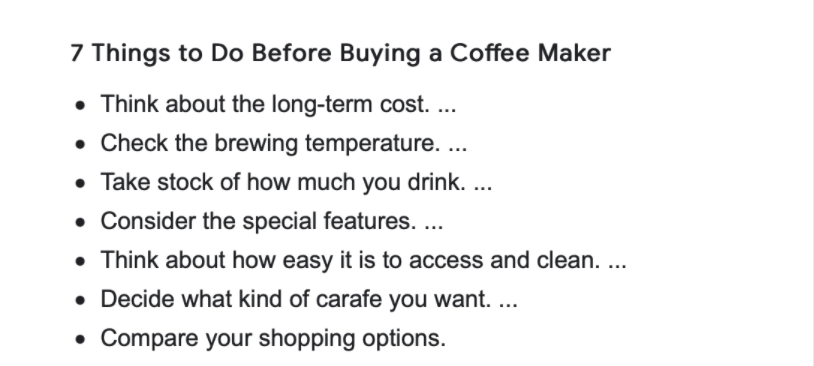
When completing my internship, with limited financial resources as a grad student, I decided to treat myself with a coffee machine. I love to drink a good cup of coffee! I looked at my budget and I could afford a coffee machine between $80 – 100.- max. The search began. Google recommend me to keep in mind these variables:
2021 11 18 17 10 32 1

My friend, a coffee snob like myself, encouraged me to consider “strength and flavor” as important qualities for this new acquisition.

In my relentless efforts to make the best decision for what a coffee machine represents to me, the amount of money, and all those variables that appear to be important, I spent 3 months dwelling on this decision. Until finally, fed up with this overthinking, I drove myself to a store and bought “a coffee machine.”

Overthinking is when thinking gets in your way of living your life.

Here are the types of overthinking patterns that you need to watch out for:

  1. Thinking about doing things right and perfectly
  2. Thinking about all the good reasons to postpone and delay stuff
  3. Thinking about how much certainty you need to move forward
  4. Thinking about the worst-case scenarios
  5. Thinking about past negative outcomes or past mistakes
  6. Thinking about not being good enough in some way
  7. Thinking about the different ways to get out of a stressful situation
  8. Thinking about how you’re the only responsible person for others’ wellbeing & important situations
  9. Thinking about how thinking is fundamentally important

While thinking carefully is an integral part of our lives, it also eject us from the present and rob us of fulfillment.


HOW DO YOU PLAY-IT-SAFE?


Complete this 7-minutes quiz
and get your Playing-it-safe Profile!!

You have Successfully Subscribed!