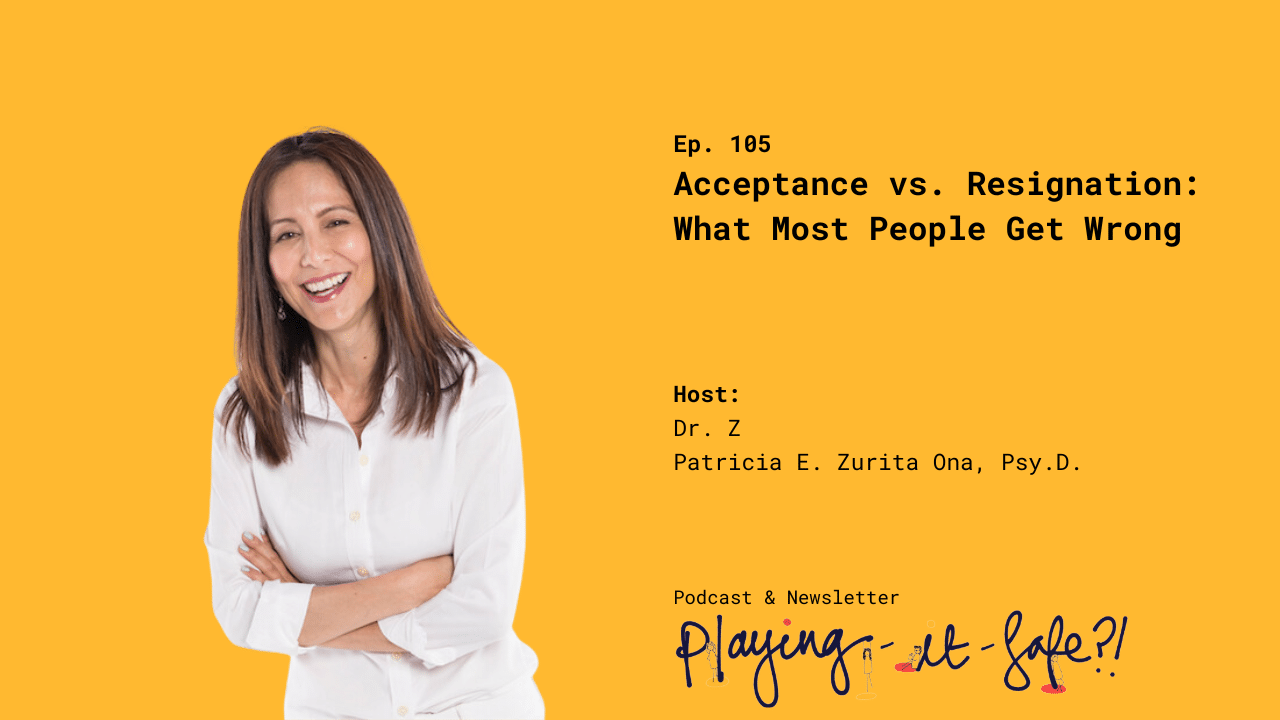
Acceptance vs. Resignation: What Most People Get Wrong

Procrastinating, postponing and delaying, Taking my thoughts too seriously

I keep hearing a version of this phrase in my office: “I’ve just accepted that this is who I am.”

And then, in the same conversation: she hasn’t pitched the idea. She turned down the speaking spot. She’s still drafting an email she wrote three weeks ago. She’s spending hours mentally rehearsing conversations she’ll then find a reason to avoid.

That’s not acceptance. That’s resignation with better vocabulary.

Acceptance doesn’t shrink your world. Resignation does.

This week’s episode is about that distinction, and what acceptance as an actual ACT skill looks like when anxiety is still very much in the room.

Show notes with time-stamps

0:00 Introducing Sophia, a high-achieving client who believed she’d “made peace” with her anxiety
0:36 How Sophia’s “acceptance” was actually an architecture of avoidance
1:36 The gap between Sophia’s outward success and her quietly shrinking professional world
2:58 Why repetitive thinking about the past/future is a playing-it-safe behavior, not coping
3:52 Defining the real difference between acceptance and resignation
4:57 What true acceptance sounds like (vs. resignation shutting the door)
6:05 Steven Hayes, ACT, and the concept of experiential avoidance
7:33 How the mind tries to “protect” you by over-analyzing pain, and why that backfires
8:25 A concrete acceptance practice you can try today: noticing the thinking loop
9:56 Sophia’s real values and the small first step she took
10:49 What acceptance is not: passivity or giving up boundaries
11:23 A listener’s email: “What I’ve accepted is a smaller life”
12:18 Acceptance doesn’t erase your history, it stops letting history make your decisions
13:05 Dr. Z’s personal story: grief after her grandmother’s death and what real acceptance felt like
14:12 Ask yourself: are you learning or just looping?
14:52 Resignation stops values-based action; acceptance makes it possible

Listen Here

​Apple​
​Spotify

Learn research-based skills and actionable steps to make better decisions, adjust to uncertain situations, make bold moves, & do more of what matters to you.


Reader transparent
Orange 2

ACT online courses 

Learn more

Learn more

Learn more

Learn more

Learn more

Learn more

About Dr. Z.

I’m originally from Bolivia, South America, and am a psychologist by training. I’m formally trained in empirically supported treatments, and when I say “formally,” I mean that since 2004 I have received intensive training in them, particularly in Acceptance and Commitment Therapy (ACT) and Cognitive Behavior Therapy (CBT). 

Over the past 18 years, I have created resources for and worked with overthinkers and overachievers dealing with all types of anxiety-related struggles: perfectionism, procrastination, productivity anxiety, uncertainty intolerance, indecision, impostor phenomenon, overthinking, phobias, rumination, panic, worry and obsessive-compulsive disorder. I absolutely love my job!

In 2019, I was nominated as a fellow by the Association for Contextual Behavioral Science because of my contributions related to the applications of ACT for anxiety-based struggles. I’m the author of seven books and the co-author of three (see the section on previously written books).

I’m the founder and director of the East Bay Behavior Therapy Center, a boutique private center in the San Francisco Bay Area that offers therapy and coaching for anyone experiencing anxiety-based struggles.

In 2023, I gave a TEDx talk, “Stop playing-it-safe and start living” that has more than 264K downloads.

While I’m a psychologist by training and science-based by passion, my style is jargon-free, accessible, caring, and lighthearted; teaching ACT skills doesn’t have to be boring or inaccessible, so I do my best to make every skill I teach—in any format—as engaging as possible. 

I believe that learning to navigate anxiety-based reactions is one of the key skills of the 21st century, and I’m passionate about it.

I'm passionate about disseminating ACT skills for anxiety-based struggles.

HOW DO YOU PLAY-IT-SAFE?


Complete this 7-minutes quiz
and get your Playing-it-safe Profile!!

You have Successfully Subscribed!

Share This