Reading Time: 3 minutes
An adult man, in his mid-thirties, walks slowly towards a microphone. He stands up stoically, opens his mouth, his face makes the natural gestures of someone talking, and yet, guttural sounds come out of his mouth followed by awkward silence. No words can be heard from his mouth, only noise.
Have you watched the movie “King’s Speech?” If no, I super-encourage you to do so; of course, only if you’re as into watching movies as I am (as you know by now).
In this film, Geoffrey Rush and Colin Firth do an amazing job acting as a psychologist and King George VI of England struggling with the fear of public speaking respectively.
George VI is scared about talking in front of others, stutters occasionally, but stutters much more when feeling anxious, when having to give speeches, when having to hold a microphone or when giving an interview to hundreds of people.
George VI taps into what we know happens when you care about something: all your fears, worries, and anxieties get amplified, maximized, and elevated to a level that it feels like you’re in a rabbit hole.
Richard, a Jewish gay man, was ready to be in a committed relationship, so he enrolled in a Jewish dating service for the gay community. After carefully crafting his profile with touches of his life represented in different pictures, he starts exchanging texts and phone conversations with potential partners. When catching up with his friends, he shared among the people he had been interacting with. Some of them were smokers, others were too fat, others eat pork regularly, others were vegan, others too short, others too tall; others loved to party too much, others seemed too religious; others were not smart enough; others were not financially stable; others were too nerds. Back to his apartment, when sitting in front of his laptop, he thought to himself “what if I don’t ever find a person? What if I made a mistake breaking up with my ex? Would I die alone, old and bold? Would I ever have a family of my own? What if I fall down in my apartment, have a concussion, and there is nobody to help? That night, Richard tried to fall asleep, but his mind kept coming back with thoughts of him being a loser, broken and unlovable. Richard really cares for living a family life, connecting with a partner, and growing together. And yet, his mind was relentless coming up with all types of worries.
When something matters to us we get concerned about messing things up for ourselves and others. We worry about things going south.
What Richard was missing is that behind all those worries, he was afraid of choosing the wrong partner; he was afraid of ending up with an imperfect partner. But, when he took those worries as facts, he ended up feeling bad about himself, hopeless, stopped connecting with potential partners, and visualized how he will end his days.
What’s behind your worries? What are your worries masking?
Can you do an inventory of the worries that are currently showing in your mind as you put your intention into something you deeply care about?
Going back to Richard, is it wrong that he was worried about finding the partner of his dreams? Not necessarily. But, what Richard was missing is a micro-skill: differentiating when going into a rabbit hole could be helpful and when it wasn’t.
Worries are creations of your dynamic minds and not necessarily thoughts to dwell on over and over for hundreds of times. I don’t think you want to spend your life as a dedicated, dutiful, and committed worrier, right?
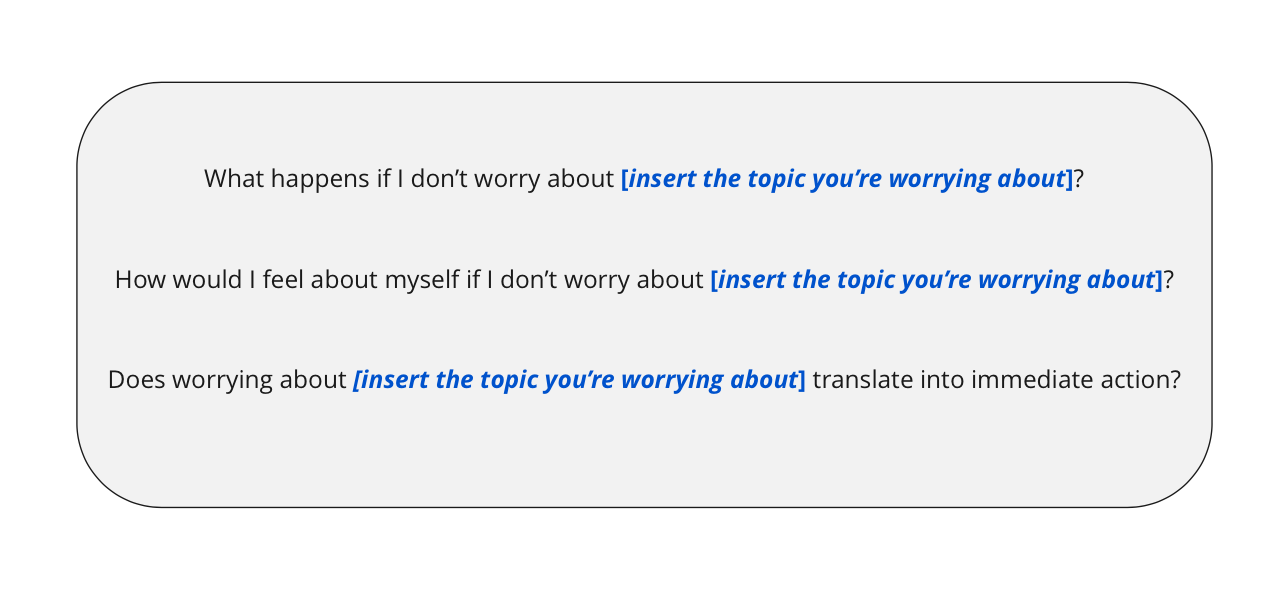
Next time you find your mind taking you into a rabbit hole, ask yourself these questions: