
Like ice-cream, there are so many types of overthinking.
Given the busyness of our minds and the unavoidable stream of thoughts we all have every moment we’re awake, it’s natural that each one of those thoughts could unfold into a thinking pattern.
You can have a thinking pattern about your morning routine, how to read a book, ask for a raise, and so on. Similarly, when facing an upsetting or anxiety provoking situation, of course, your mind is going to come up with a thinking pattern about how to manage, handle, and take care of what’s stressing you out.
The more that you rely on those thinking patterns, the more they get reinforced, get established, and get generalized to similar situations:
Here is the deal:
There are an alarming number of major life decisions we need to make: who we choose to marry, the school we go to, the house we want to buy, the next job you need to apply to, a relationship you need to get out from, the location where you want to retire, the amount of money you need to retire, and so on. Each one of those decisions requires careful thinking, for sure.
Simultaneously, there are day-to-day decisions, banal ones that we also get stuck on at times: the size of the TV you are going to buy, the coffee machine you need to get for your office, the model of the cell phone you’re going to get, how you spend your time, which task to focus on first given the laundry list of things you have to take care of, the type of laptop you need for creating videos, the destination of your next vacation, the veterinarian for your pet, the book you’re going to read to your children. And so on.
Whether you’re making a major life decision or day-to-day one, all of them can be anxiety provoking. Naturally, as all humans do, you think of that particular situation as an attempt to solve it and with that, to solve your discomfort, struggle, uncertainty, and stress with it.
It’s all that thinking you do that evolves into overthinking patterns that, paradoxically, instead of moving you forward, it keeps you stuck in your head in the long run. It’s like overthinking is a safety move.
When completing my internship, with limited financial resources as a grad student, I decided to treat myself with a coffee machine. I love to drink a good cup of coffee! I looked at my budget and I could afford a coffee machine between $80 – 100.- max. The search began. Google recommend me to keep in mind these variables:
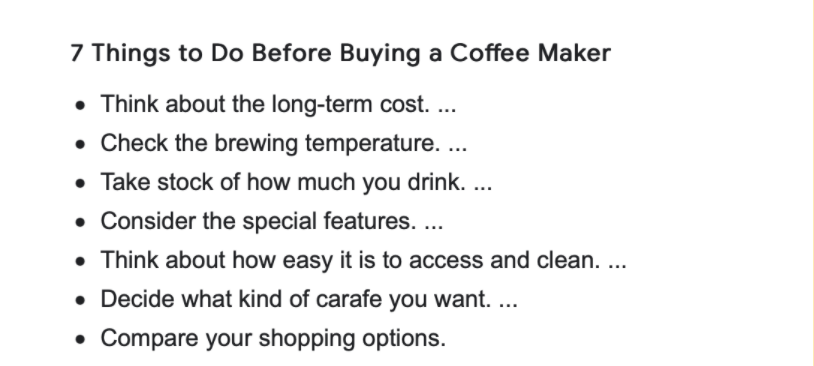
My friend, a coffee snob like myself, encouraged me to consider “strength and flavor” as important qualities for this new acquisition.
In my relentless efforts to make the best decision for what a coffee machine represents to me, the amount of money, and all those variables that appear to be important, I spent 3 months dwelling on this decision. Until finally, fed up with this overthinking, I drove myself to a store and bought “a coffee machine.”
Overthinking is when thinking gets in your way of living your life.
Here are the types of overthinking patterns that you need to watch out for:
- Thinking about doing things right and perfectly
- Thinking about all the good reasons to postpone and delay stuff
- Thinking about how much certainty you need to move forward
- Thinking about the worst-case scenarios
- Thinking about past negative outcomes or past mistakes
- Thinking about not being good enough in some way
- Thinking about the different ways to get out of a stressful situation
- Thinking about how you’re the only responsible person for others’ wellbeing & important situations
- Thinking about how thinking is fundamentally important
While thinking carefully is an integral part of our lives, it also eject us from the present and rob us of fulfillment.