The many shades of avoidance, dirty words, & powerful moves

The many shades of avoidance, dirty words, & powerful moves

When was the last time you felt anxious, worried, or scared? How did it feel?

Feeling anxious is not your fault; anxiety just happens and although it feels super-uncomfortable, it’s a natural, adaptive, and healthy reaction we experience to a potential threat.

You may be wondering if it’s natural, why it feels awful and why for some people it’s like living in hell.

The answer is in how you respond to your anxious feelings when they show up! What do you do when feeling anxious? How do you handle that anxious state?

There are two variables that differentiate an effective response from an ineffective response when dealing with fear-based reactions:

(a) The way you think of fear-based reactions.

(b) The way you respond to fear-based reactions.

Let’s dive into these two variables:

(a) The way you think of fear-based reactions

When feeling scared, anxious, afraid, or in panic, you may have learned to look at those experiences in ways with a negative lens and take all those thoughts as the absolute truth with capital T.

Popular thoughts about fear-based reactions are:

– Thinking of fear-based reactions as “bad.”
E.g. I shouldn’t be feeling afraid.

– Thinking of fear-based reactions as “a sign that you’re in danger.”
​
E.g. When noticing that your heart is beating fast, you may have thoughts that it is a sign that you may have a heart attack.

– Underestimating your ability to handle those feelings
​
E.g. I won’t be able to manage my anxiety.

– Overestimating a catastrophic ending
​
E.g. it will be really bad, terribly bad.

Quick clarifications:

– I’m not saying that fear-based reactions are fun, easy to have, and enjoyable; I know they suck and yet, we’re wired to have them.

– There are times in which we’re definitely surrounded by threat – e.g. someone pointing a gun at us, someone stealing our purse, etc. – but most of the time, the degree of threat our mind perceives – perceived threat – is related to how we interpret a feeling, thought, sensation, or a situation.

The tricky part with how you’re thinking of fear is that Instead of acknowledging that your mind is trying to protect you, as it usually does, you get consumed with those thoughts and act accordingly: you avoid whatever is starting a fear-based reaction.

(b) The way you respond to fear-based reactions

Humans, we don’t like to be in discomfort, struggle, or basically being in pain. So, naturally, we run away, minimize, and do everything we can to get out of an uncomfortable situation. A common response to anxiety is experiential avoidance.

Experiential avoidance refers to all the things we do to avoid unpleasant feelings resulting in short-term relief but making things worse in the long term. There are five basic types of avoidant behaviors:

​

email

​
Situational Avoidance

With this form of avoidance, you stay away from anything that triggers fear-based reactions like:

– People
E.g. you avoid your new manager, mother-in-law, or police officers

– Places
​
E.g. elevators, trains, and planes

– Animals
E.g. spiders, rats.

– Objects
E.g knives, plastic bags, needles..

– Activities
E.g. eye contact, public speaking, asking a question in a group, large parties.

Cognitive Avoidance

Cognitive avoidance refers to all the thinking strategies you do privately in your mind to avoid any form of anxiety. There are different forms of cognitive avoidance:

– Suppression
Actually saying to yourself, “don’t think about that. Just don’t go there.”

– Worrying
Thinking about all potential what-if scenarios in the future.

– Rumination
Thinking about past scenarios and running them over and over in your mind.

– Replacing thoughts
​
Sometimes, people attempt to replace one distressing thought, image, or memory with positive content.

– Mental rituals
​
You may pray in a specific way as a way to protect yourself from something bad happening, but if for whatever reason you don’t do so, you cannot move on with your day.

Somatic Avoidance

When dealing with somatic avoidance, you do your best to not experience internal physical sensations associated with fear. For example, you may be hypervigilant if you experience shortness of breath, feeling hot, feeling fatigued, and so on.

Emotional Avoidance

With this particular form of avoidance, you intentionally try to minimize, suppress, & get rid of uncomfortable emotions. An example is Harold, who struggled with not knowing if he made a bad decision at work so, when feeling uncertain, he began drinking in an effort to avoid this feeling.

Preventive avoidance

S. Hoffman & A. Hay (2018) in a review of different types of avoidant behaviors, identified what is called “preventive avoidance.” Preventive avoidance are all those actions that you do to prevent your experiencing fear-based responses either before or after a triggering situation. For example, if you’re intensely afraid of making a mistake, you may check the task you’re working on multiple times; or after sending an email, you may call the person who received it to make sure you didn’t say anything offensive.

As you can see, avoidance has so many shades; sometimes you may be engaging in one specific form of it or a combination of them. The reality is that these types of avoidances co-exist with each other and don’t show up in isolation. I only broke down the concept of experiential avoidance to help you to consider how you’re responding to a triggering situation and how – without knowing – you may be feeding into the cycle of anxiety.

Just to clarify, while avoidance makes things worse when dealing with worries, fears, anxieties, and obsessions, it’s not a dirty word. Sometimes, avoidance can be adaptive; for instance, when dealing with a problem at work, you may have this urge to talk to others about it because you feel very anxious and receiving emotional support makes those feelings go away and doesn’t interrupt your day-to-day life; pretty adaptive, right?

The challenge is when using experiential avoidance as your go-to response to anxiety-provoking situations; in the short-term, avoidant behaviors help you to avoid an unpleasant moment, but tomorrow you must face the likelihood of the same uncomfortable situation welling up again and again. It’s like the depth and height of what you do is limited by your day-after-day attempts to avoid bad experiences that are, ultimately, unavoidable.

Now that you’re familiar with particular ways of thinking about fear-based reactions and different types of avoidances, I hope you can see how both variables can lead you from experiencing anxiety as a natural emotional state – that we all experience – to a problem that needs to be solved.

​

email

​
At the end of this long newsletter, I want to leave you with three questions for you to ponder about any avoidant behaviors you’re doing right now.
​

– What am I avoiding that I want to approach?

– What do I want to do that I’m afraid of?

– What’s the fear holding me back from?

– How is this affecting my day-to-day life?
​

Learning to make room for any fear-based reactions, without letting them take over our life is possible. And it all starts with dissecting our fears.

Awareness is one of the most powerful moves you can start practicing.

Do you want to get unstuck from wrestling with worries, fears, anxieties, obsessions, and ineffective playing-it-safe actions?

Learn research-based skills and actionable steps to make better decisions, adjust to uncertain situations, make bold moves, and do more of what matters to you.


Reader transparent
Orange 2

Getting mobilized: from behavioral avoidance to behavioral activation (part 6)

Getting mobilized: from behavioral avoidance to behavioral activation (part 6)

It’s time to unlearn avoidant behaviors that have been keeping you stuck. Making a shift from behavioral avoidance to values-based living requires that, in addition to clarifying your values and identifying the fun, to-dos, and meaningful activities you have been avoiding, you also identify potential blocks ahead of time.

For example, Anne, identified the following roadblocks:

Screenshot 2020 11 24 161002

Your turn. What are the roadblocks that you anticipate may show up for you? Don’t worry if they seem silly or stupid, just write them down so you can make an action plan for each one of them:

Screenshot 2020 11 24 161031

As you work through this workbook, you will learn many skills to handle unpleasant internal experiences and all types of roadblocks that may show up and get in your way. So I invite you to be patient with your learning.

Next, you will learn two specific ways to handle your roadblocks:

(1) Visualizing the steps required for each activity

If you’re concerned about experiencing some internal discomfort when taking steps to implement your weekly calendar, visualizing each one of the steps you need to go through is a safe way to practice making room for that discomfort.

Choose one activity to work on. Close your eyes and mentally walk yourself through all the steps you need to take to achieve your goal. Use all of your senses to experience each step as vividly as you can. Who are you with? What do you do or say? What are the circumstances? As you visualize the sequence of events in detail, note any thoughts, feelings, and sensations that might interfere with acting in accordance with your values and achieving your goal. As you notice your internal experiences, say to yourself, Here is an emotion, here is a thought. Do your best not to fight any of the internal experiences; simply acknowledge them as you continue visualizing the steps you need to take to complete that activity.

(2) Coming up with a problem-solving plan

Some of the activities you identified in your action plan may seem big, unbearable, or undoable. To help, you can practice visualizing the necessary steps to complete the activity, and you can also come up with a modified action plan to increase the likelihood of having your ideal outcome.

For example, let’s look at Anne’s roadblock for one of her values-based activities:

Screenshot 2020 11 24 161051

As you can see, having a modified action plan makes things more manageable because you’re breaking them down into micro-steps. Your turn.

Screenshot 2020 11 24 161110

Notice what happens when you make an effort to establish a modified action plan for a potential roadblock or visualize the steps you need to take. Don’t you feel that the task is more manageable? These are super-handy tools that will get you mobilized.

After you have identified and solved these potential roadblocks, let’s increase your willingness and motivation to make it happen. The next section will help you with that.

Committing to your weekly calendar

Committing to behavioral change improves your motivation and willingness to increase your activity levels and overcome different forms of avoidance (Hayes and Smith 2007). Keep in mind that committing to your weekly calendar is not about agreeing with a particular outcome; it’s about committing to experience, sit with, and stay with what comes with that decision. With every choice you make, there is an experience that comes as a result of the choice.

Here is an exercise to do:

For this particular activity: ________ [enter the activity].
I am willing to experience ________ [enter the type of discomfort you may experience].
So I can ________ [insert the benefits of implementing that particular action].

In the case of Anne, her commitment exercise looks like this:

For this particular activity: going for breakfast on Friday.
I am willing to experience fear about things going wrong.
So I can connect with my partner on an intimate level and nourish my relationship.

If you put into action all these steps on a weekly basis, you will notice a shift in your day-to-day life. The key is acting on your values, taking care of the errands you need to do, and having fun activities on a regular basis.

A rich life has multiple sources of joy, experiences, and encounters, and this variability of experiences is actually key to break avoidance patterns and live the life you want to live. Share on X

Getting mobilized: from behavioral avoidance to behavioral activation (part 5)

Getting mobilized: from behavioral avoidance to behavioral activation (part 5)

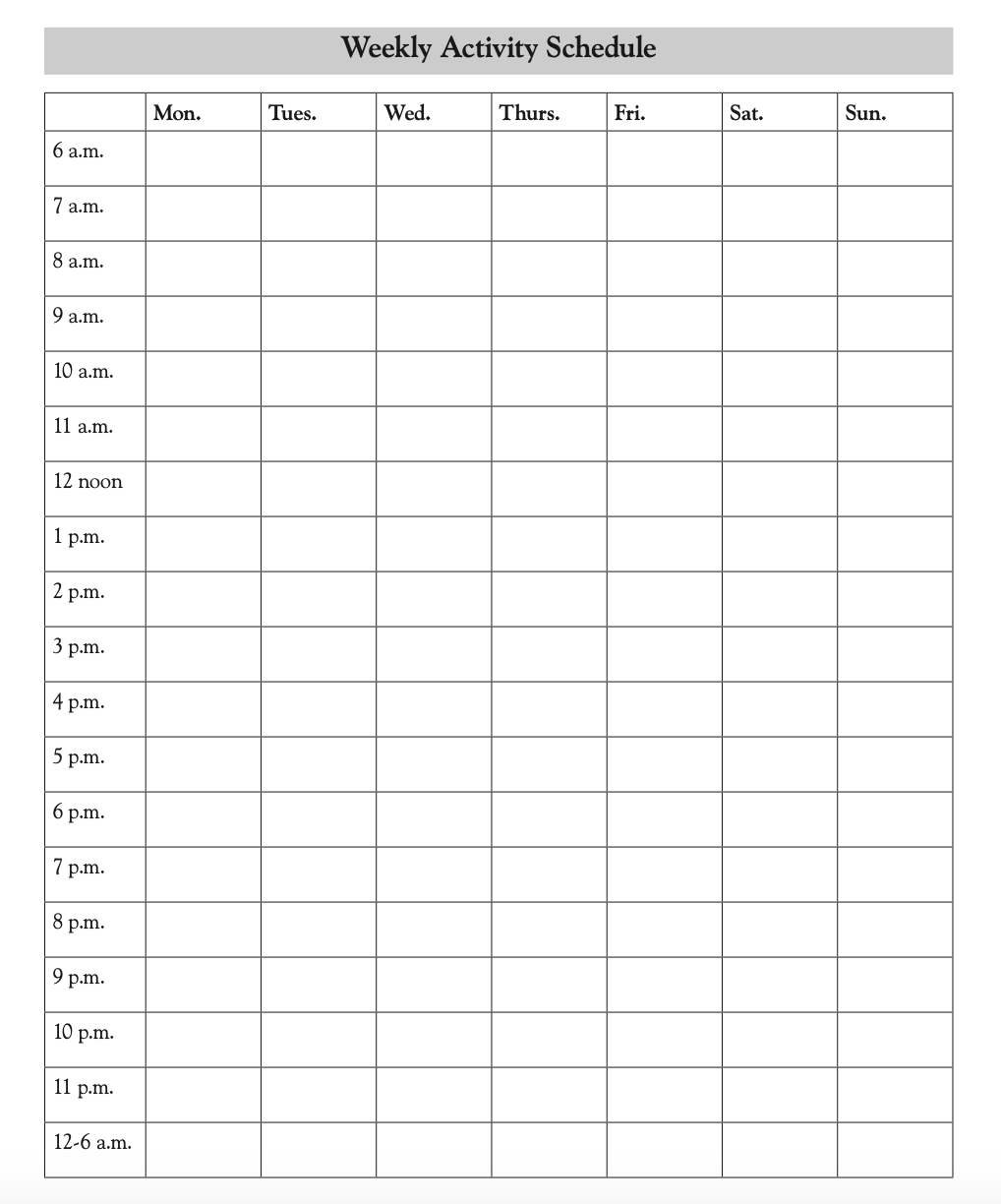
Now that you have identified your values-based actions (part 2), must-do tasks (part 4), and fun activities (part 3), let’s schedule them. You may wonder, Why do I have to schedule them, if I know what I need to do? A simple reason: tracking what we do and how we spend our time keeps us accountable and motivates us to keep moving.

Our calendars reflect how we want to live our life. Share on X

So, here is what you need to do:

  • Grab a pen and a weekly calendar (like the one below).
  • Go back to the exercise identifying values-based activities and, looking at your week, schedule one values-based activity. Next to it, enter the letter “V” for values.
  • Go back to the exercise identifying fun, enjoyable, and pleasurable activities, and schedule one of those activities. Next to it, enter the letter “F” for fun.
  • Go back to the exercise identifying must-do activities you need to take care of and schedule one of them. Next to it, enter the letter “O” for must-do.

You can start scheduling one activity from each category, and increase them as you move forward. Slow but steady!

As you complete this exercise, you will see that your weekly calendar is the first step to activating the life you want to have.

Exercise: Building your weekly calendar

part 1 table

Congratulations, now you have your weekly calendar. That’s a big step!

Living the life you’re designing is possible. And yet, it won’t be handed to you on a silver platter. So, let’s anticipate and go over potential roadblocks that may come your way as you get back into your life (part 5).

Getting mobilized: from behavioral withdrawal to behavioral activation (part 4)

Getting mobilized: from behavioral withdrawal to behavioral activation (part 4)

In part 3 of this series getting mobilized, you were invited to identify all those fun activities that you have been postponing. Now, the reality is that our lives also involve activities that must get done: paying bills, going to medical appointments, grocery shopping, and so forth.

If you have been dealing with shame, low mood, depression, or anxiety, it’s quite likely that you have also disconnected from these activities as well. As a result, you may have a pile of postponed responsibilities that are causing you more distress than the actual steps you need to take care of them.

Let’s do an inventory of all those activities you need to do and have been procrastinating right now.

Exercise: Identifying must-do activities you need to take care of


Screenshot 2020 11 24 160829


If you have been completing all exercises from part 1, part 2, and part 3, by now, you have a solid inventory of the stuff you care about, stuff that is fun, and stuff you need to do that you have been disengaged and disconnected from. This is a great starting point to continue making a shift into getting mobilized and living the life you want to live.

“You have brains in your head. You have feet in your shoes. You can steer yourself any direction you choose.”
Dr. Seuss

The next blog post focuses on putting all of them together in your weekly calendar you can you get back on track!

Getting mobilized: from behavioral avoidance to behavioral activation (part 3)

Getting mobilized: from behavioral avoidance to behavioral activation (part 3)

Withdrawing behaviors happen not only with the activities that are important to you, but also with things that are fun, enjoyable, and pleasurable. In this series, Getting Mobilized: From Behavioral Avoidance to Behavioral Activation, you’re learning different steps to get back on track.

In part 1, you learned the different empirically-supported approaches for dealing with withdrawal, disconnecting, and disengagement. In part 2, you were asked to identify your values and hold onto them as the compass of your behavior. But when feeling down, a common go-to behavior is to disconnect not only from activities that are important to us but also from the fun, enjoyable, and pleasurable things we like to do. In this blog, you are invited to identify those common, day-to-day, fun activities you have been avoiding and want to start participating in.


“We are more often frightened than hurt; and we suffer more from imagination than from reality.”

Seneca


If you have a hard time coming up with ideas, here is a list of popular ones for inspiration. Keep in mind that this list is a generic one, and you may want to add a more-specific activity. For instance, if “exercising” is something you want to start doing again, try to narrow the activity to running, biking, or whatever you enjoy doing.

  • Visiting friends or family
  • Talking to friends or family on the phone
  • Going to movies or plays
  • Watching videos or TV
  • Exercising
  • Playing games
  • Chatting on the Internet
  • Listening to music
  • Going away for a weekend
  • Planning a vacation
  • Pursuing a hobby
  • Collecting
  • Doing crafts
  • Enjoying the sun
  • Walking or hiking
  • Reading
  • Gardening

If you are still struggling with coming up with some ideas, ask your friends and relatives for suggestions. Also, think back over the years to the things you’ve enjoyed. Try to remember everything you’ve ever done that was fun.

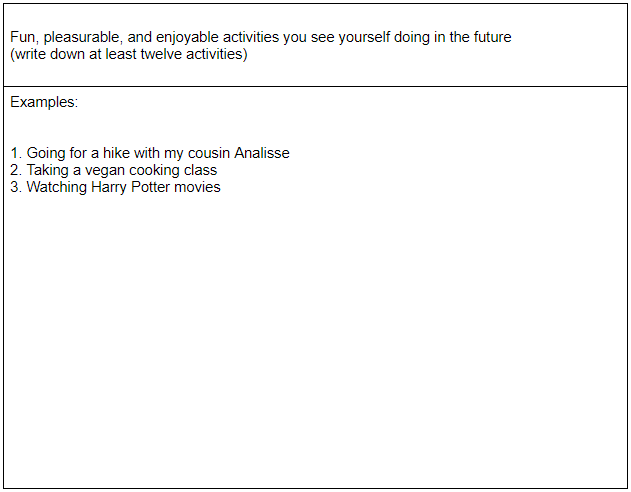
Now, take some time to jot down specific activities that you have enjoyed or can imagine enjoying in the future.

Exercise: Identifying fun, pleasurable, and enjoyable activities


XX


In the next blog, we will look at another type of activities you may have been struggling with because of ongoing disconnecting behaviors. Let’s break the cycle of inactivity, and let’s get you moving.

Getting mobilized: from behavioral avoidance to behavioral activation (part 2)

Getting mobilized: from behavioral avoidance to behavioral activation (part 2)


In part 1 of this series, engagement: from behavioral avoidance to behavioral activation, you did an assessment of how you’re spending your time and inventory on all the stuff you have been avoiding. Now, to get back into your life you will learn how to go back to your values, fun activities, and your to-dos.

This blog post focuses specifically on getting you back on track by doing what you care about.

“Work on Purpose, Play on Purpose, Rest on Purpose. Do not let yourself or anyone else waste your time.”
Izey Victoria Odiase

Getting mobilized with your values

Values have been the source of inspiration for artists, creators, makers, and almost every single person on Earth who wants to live with meaning, purpose, and intention. “Values” is a word that gets thrown around a great deal these days, and it means different things to different people. Based on Acceptance and Commitment Therapy, and for the purposes of this series, let’s think of values as the response to these key questions:

Are you living the life you want to live?
What sort of person do you want to be?
Are you the relative you want to be?
Are you doing what matters to you as a friend?
Are you treating yourself the way you really, deeply want in your heart?

Before we dive into figuring out your values, a couple of clarifications:

  • Values are different from goals

Values are the “why” of what you do, and they’re different from goals. Goals are specific stepping stones along the path leading you in the direction of your values. Goals are actions that are completed and checked off a list. For instance, Rebecca, as a mother, identifies her value as “being caring” and her goals are to 1) prepare a meal for her daughter three times a week, 2) drive her daughter to school twice a week, and 3) attend her daughter’s volleyball games on the weekends. In essence, Rebecca sets her goals and actions in line with her values; her actions may change, but her values don’t.

  • Values are not feelings

We are all wired to experience a full range of emotions—that’s our natural makeup—but experiencing one feeling versus another does not mean you’re living your values; you’re just feeling. And our feelings, like waves in the ocean, come and go. You don’t have control of what you feel, but you do have control over how you act and how you want to live your life. Now let me break the news to you: those are also dead goals because, as much you may wish it were true, you don’t have control over what you feel. You simply feel what you feel. But values are not about feeling good. In fact, living your values and doing what matters comes with uncomfortable feelings at times.

For instance, for Joe, being caring with his relatives is a core value; every month he travels for six hours to spend a weekend with his ninety-year-old grandmother who cannot travel, barely recognizes him, and requires assistance at all times. As soon as he arrives, Joe changes her clothing, grooms her, reads her a favorite book, and leaves pictures of her great-grandchildren. Even when she calls him by the wrong name, he holds her hand. Joe feels sad and frustrated, and he believes it is unfair that a woman who raised nine children is slowly dying. Yet even though performing these actions in service of his values makes him uncomfortable, he does them.

  • Values are not about avoiding feelings

If your mind says that the outcome you want in life is to feel less pain, to have less intense and fewer stressful emotions like anxiety or sadness, I totally get it. It’s understandable that we don’t want to feel any discomfort because it’s no fun at all. But here’s where this thinking gets tricky. A client told me once that being funny was a very important value for him; when I asked more about it, he said that telling jokes and being funny makes him likable to others and creates a good impression. When asked what would happen if he isn’t funny, he said that he would be worried about not being liked and would even be afraid of people no longer wanting to be friends with him. For my client, acting funny is not a value but emotional escapism. He is avoiding the feeling of being disliked or abandoned by others. Values-based on running away from painful emotions are not actually values, because the actions you do actually take you away from your values.

  • Values are not your preferences

There are things that we like, love, and go out of our way to get. For instance, you may love your morning coffee, a sunny day on the beach, or salsa dancing; all those things are nice and fun, and you may want to have a lot of those moments, but those are preferences, not values. Your morning coffee, as tasty as it is, isn’t pointing you in the direction of doing what matters to you; your values do that. Your values are like the arrow on a compass that points the way for you to go.

  • Values are not your wishes for others’ behaviors

Sometimes, when having a conversation about values, I hear comments along the lines of “I want to be respected by others.” It’s natural to want to be seen, appreciated, and respected by others, and we certainly deserve it. But, here is the takeaway: we simply do not have control of other people’s reactions, behaviors, and feelings about us. Now that we have gone over a few points about values, I hope you can see that living your values is an actionable task. Taking steps toward what matters to you gives you a new way of being in the world; it is not pain-free, but it means you get to choose how you want to live your life, instead of your emotions choosing for you and dragging you around in the process. The more steps you take toward becoming the person you want to be, the better it gets—and as they say, “What you practice grows.” The next section of this chapter will help you to clarify what matters to you and how you can take steps toward them. Screen Shot 2020 11 23 at 11.35.37 PM

Identifying your values

Below are two exercises that you can use as a guide to identify your values; feel free to do both of them since they are complementary.

Exercise 1: Identifying your values (part 1)
Grab a piece of paper and write about three different moments when you had a sense of vitality and felt alive, when you were doing what speaks deeply to you, when in that moment life was just perfect. Describe each situation, the person you were with, and what you were doing. Imagine that someone was recording you in those moments—what would they see in the camera? After recalling and writing about these three different memories, try to identify any qualities that stand out to you across all of them. Ask yourself: What was special for me about those moments? How did I feel about myself? What was the quality or way of being I was embracing that made me feel good in those moments? Your answers will point you to your values. Write them down, keeping in mind that your values are verbs. You don’t need to have a shopping list of your values, just a refined list of what you strive to be and stand for in your personal life. As a reference, you can look at this list of values:


Screen Shot 2020 11 21 at 10.21.29 AM


For instance, after completing this exercise, Anne came up with the following sweet memories:

Memory 1: When celebrating my daughter’s sixth birthday, I looked at her and felt a strong sense of connection with her and felt how much I wanted to be a constant part of her life in a way that she knows I love her.

Memory 2: On a rainy day, my partner and I were struggling to figure out what to do to entertain ourselves. We flipped channels and didn’t see anything interesting. We thought about eating, but nothing seemed exciting. We decided to walk our dog in our neighborhood and, to my surprise, that was one of sweetest moments we had. It was cold, we were wearing our heavy jackets, but when walking together we remembered the first home we had, how hard we worked for it, how we decorated it, how much we argued about the tile in the bathroom, and how we couldn’t stop smiling when thinking of the bright yellow door we painted in the kitchen. I felt so clear about not needing extravagant or fancy things all the time to enjoy myself and my husband’s company.

Memory 3: I remember a tough conversation I needed to have at work with my sister, who was also my manager, about a salary raise. I couldn’t sleep for days, felt anxious, and asked for advice from any person I could find. In the past, no matter what I asked for, whether it was for something at work, at home, or anywhere, my sister would usually say no. Somehow she still sees me as the youngest kid and doesn’t want me to get away with stuff. Ridiculously, as an adult she still treats me like that. So, I usually don’t bother asking or insisting on what I need. This time, I prepared a draft of what I was going to tell my sister and rehearsed in front of a mirror. I even had a back-up plan if she didn’t raise my salary. On the day of our meeting, I made sure I had my coffee, wore my favorite sweater, and then walked to her office. She was friendly and then asked about my request for revising my salary. In those moments, I felt my body get sweaty all over, and I felt a rush like I wanted to run away, but I stayed and told her that I needed a raise and recited the reasons why. My sister looked at me, didn’t say much while I was talking, and after nodding her head, she said that she would think about it and discuss it. She wanted me to know that no one in my department had received a raise in the last six months. I was prepared for my sister to say something like that, so I took a deep breath, and then asked her when she could give me a response because I needed to make decisions accordingly. For the first time, I didn’t walk away from a conflict, didn’t apologize for asking for what I needed. And even though I didn’t get the raise immediately but instead two months later, I knew I did the right thing for myself. When writing down these three memories and going over them, Anne identified these personal values: being caring, down to earth, and authentic.

Jot down below the values you came up with; when doing so, don’t worry about finding the perfect word or the perfect value, just list the principles that you want to embrace in your life and be remembered for by others. The purpose of this exercise is not to identify the perfect value but to get in touch with what truly matters to you.

 

Screenshot 2020 11 24 160554


Exercise 2: Identifying your values (part 2)
Read the following directions slowly, and then see what you come up with at the end of it. Imagine that you have lived your life the best you could up to this point. Some things went as you wanted them to go, some things were difficult, but here you are today. You planned some things and others just happened. However, things take a dramatic new course for you in this moment: Right now, you’re being notified that you’re going to die in the next twenty-four hours. Yes, that’s right, imagine that you’re going to die within the next twenty-four hours. Suddenly you may start breathing fast and realize you only have a short amount of time to be alive and prepare for your final departure. You might ask yourself: Given how things are right now, what type of person do I want to be? You’re living your last day on earth. You’re running out of time. There is no turning back. This is it. Please reflect on this, and instead of rushing to answer, breathe, and jot down your response.


Screenshot 2020 11 24 160554


Now that you have completed two exercises to identify what truly matters to you, let’s move on to acknowledging the life areas that you care about.

Exercise 3: Identifying areas that are important to you
People tend to have strong values in ten general areas of life (Hayes and Smith 2005). Some of these areas will be more important to you than others. Read through the following descriptions of these domains and circle four that are most important to you.

Intimate relationships. What kind of partner do you want to be with your significant other?
Parenting. What is most important to you about parenting your kids?
Friends and social life. How do you want to show up to your friends?
Health. What’s important to you when you think about your health?
Family relationships. What is most important about your relationships with your parents and siblings?
Spirituality or religion. What’s important for you in this area?
Community life and citizenship. How do you want to show up to others in your community?
Work and career. What are the qualities you want to embrace at work and in your career?

Now that you have a sense of your values and the areas of your life that are important to you, write down the four areas and respective values you want to start focusing on and commit to working on as you move forward:


Screenshot 2020 11 24 160638

.

Going back to Anne, she identified the following values and area:


X


You will be coming back to this exercise, so be sure to earmark it so you can return to it as you continue reading this series. Here is another thing to keep in mind about values: words about values without any action are like beautiful leaves swept away by the wind. We don’t want your values blown away. Instead, let’s move into identifying specific steps you can take to live those values

Identify actions toward your values

You cannot explore New York by driving the streets of Seattle, right?

The same applies here: You cannot live your values by taking actions in random directions. Rather, you must intentionally choose specific actions, steps, and goals you need to take in the right direction. How do you do it? By answering the three W questions: What, When, and with Whom.

For instance, Anne decided to live her value of being a caring daughter by spending every Saturday with her mom, who is struggling with Alzheimer’s disease. She did this even when her mother didn’t recognize her, or thought Anne was her cousin, or didn’t talk at all. Anne drove two hours every Saturday to spend the day with her mom, even when she thought, She doesn’t even know who I am.” and Does she know what I’m doing? and How did this happen to her? and It’s not fair. In the end, Anne wouldn’t trade those Saturdays for anything.

It’s your turn to identify specific actions that will bring your life into closer alignment with your key values. When thinking of actions and goals, keep in mind the following principles:

– Goals and actions must be concrete and achievable, given your circumstances.
– Goals and actions must be specific, answering who, why, how, where, and for how long.

You can use a worksheet like the one below as an aid in this process. As a starting point, I invite you to choose only four areas from all the ones mentioned above. In the first column, write the area you want to focus on. In the next column, write at least three values for each area. And in the last column, think of a specific action you can do that reflects the key value.

Exercise: Identifying your values-based activities.


Screenshot 2020 12 01 144417


The next blog post will focus on other activities that you may have withdrawn from and need to restart to get fully mobilized and back into your life!

HOW DO YOU PLAY-IT-SAFE?


Complete this 7-minutes quiz
and get your Playing-it-safe Profile!!

You have Successfully Subscribed!