Getting mobilized: from behavioral avoidance to behavioral activation (part 5)

Disengaging and using safety crutches, Procrastinating, postponing and delaying

Now that you have identified your values-based actions (part 2), must-do tasks (part 4), and fun activities (part 3), let’s schedule them. You may wonder, Why do I have to schedule them, if I know what I need to do? A simple reason: tracking what we do and how we spend our time keeps us accountable and motivates us to keep moving.

Our calendars reflect how we want to live our life. Share on X

So, here is what you need to do:

  • Grab a pen and a weekly calendar (like the one below).
  • Go back to the exercise identifying values-based activities and, looking at your week, schedule one values-based activity. Next to it, enter the letter “V” for values.
  • Go back to the exercise identifying fun, enjoyable, and pleasurable activities, and schedule one of those activities. Next to it, enter the letter “F” for fun.
  • Go back to the exercise identifying must-do activities you need to take care of and schedule one of them. Next to it, enter the letter “O” for must-do.

You can start scheduling one activity from each category, and increase them as you move forward. Slow but steady!

As you complete this exercise, you will see that your weekly calendar is the first step to activating the life you want to have.

Exercise: Building your weekly calendar
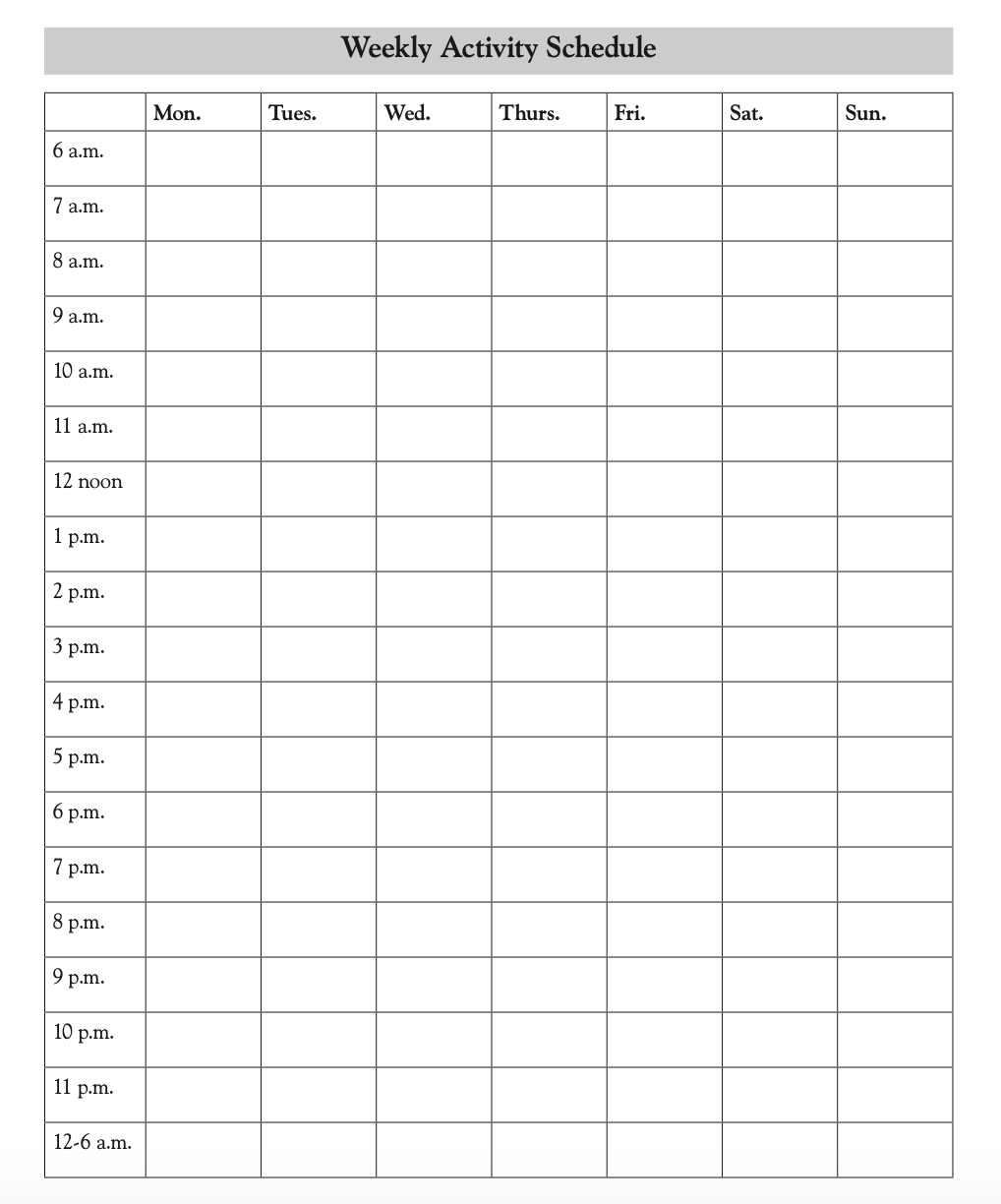
part 1 table

Congratulations, now you have your weekly calendar. That’s a big step!

Living the life you’re designing is possible. And yet, it won’t be handed to you on a silver platter. So, let’s anticipate and go over potential roadblocks that may come your way as you get back into your life (part 5).

ACT online courses 

Learn more

Learn more

Learn more

Learn more

Learn more

Learn more

About Dr. Z.

I’m originally from Bolivia, South America, and am a psychologist by training. I’m formally trained in empirically supported treatments, and when I say “formally,” I mean that since 2004 I have received intensive training in them, particularly in Acceptance and Commitment Therapy (ACT) and Cognitive Behavior Therapy (CBT). 

Over the past 18 years, I have created resources for and worked with overthinkers and overachievers dealing with all types of anxiety-related struggles: perfectionism, procrastination, productivity anxiety, uncertainty intolerance, indecision, impostor phenomenon, overthinking, phobias, rumination, panic, worry and obsessive-compulsive disorder. I absolutely love my job!

In 2019, I was nominated as a fellow by the Association for Contextual Behavioral Science because of my contributions related to the applications of ACT for anxiety-based struggles. I’m the author of seven books and the co-author of three (see the section on previously written books).

I’m the founder and director of the East Bay Behavior Therapy Center, a boutique private center in the San Francisco Bay Area that offers therapy and coaching for anyone experiencing anxiety-based struggles.

In 2023, I gave a TEDx talk, “Stop playing-it-safe and start living” that has more than 264K downloads.

While I’m a psychologist by training and science-based by passion, my style is jargon-free, accessible, caring, and lighthearted; teaching ACT skills doesn’t have to be boring or inaccessible, so I do my best to make every skill I teach—in any format—as engaging as possible. 

I believe that learning to navigate anxiety-based reactions is one of the key skills of the 21st century, and I’m passionate about it.

I'm passionate about disseminating ACT skills for anxiety-based struggles.

HOW DO YOU PLAY-IT-SAFE?


Complete this 7-minutes quiz
and get your Playing-it-safe Profile!!

You have Successfully Subscribed!

Share This