Withdrawing behaviors happen not only with the activities that are important to you, but also with things that are fun, enjoyable, and pleasurable. In this series, Getting Mobilized: From Behavioral Avoidance to Behavioral Activation, you’re learning different steps to get back on track.
In part 1, you learned the different empirically-supported approaches for dealing with withdrawal, disconnecting, and disengagement. In part 2, you were asked to identify your values and hold onto them as the compass of your behavior. But when feeling down, a common go-to behavior is to disconnect not only from activities that are important to us but also from the fun, enjoyable, and pleasurable things we like to do. In this blog, you are invited to identify those common, day-to-day, fun activities you have been avoiding and want to start participating in.
“We are more often frightened than hurt; and we suffer more from imagination than from reality.”
Seneca
If you have a hard time coming up with ideas, here is a list of popular ones for inspiration. Keep in mind that this list is a generic one, and you may want to add a more-specific activity. For instance, if “exercising” is something you want to start doing again, try to narrow the activity to running, biking, or whatever you enjoy doing.
- Visiting friends or family
- Talking to friends or family on the phone
- Going to movies or plays
- Watching videos or TV
- Exercising
- Playing games
- Chatting on the Internet
- Listening to music
- Going away for a weekend
- Planning a vacation
- Pursuing a hobby
- Collecting
- Doing crafts
- Enjoying the sun
- Walking or hiking
- Reading
- Gardening
If you are still struggling with coming up with some ideas, ask your friends and relatives for suggestions. Also, think back over the years to the things you’ve enjoyed. Try to remember everything you’ve ever done that was fun.
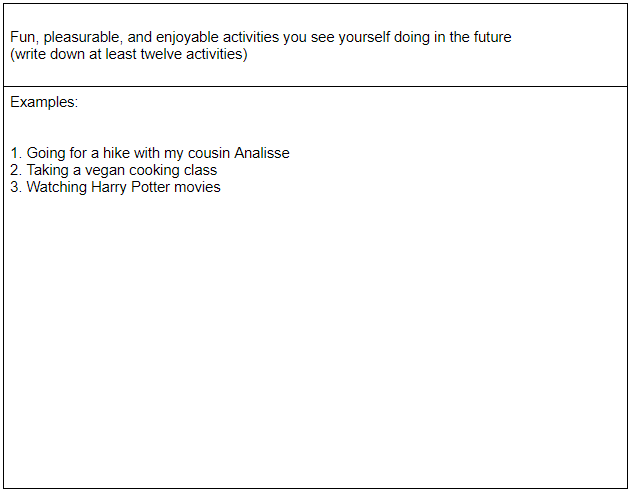
Now, take some time to jot down specific activities that you have enjoyed or can imagine enjoying in the future.
Exercise: Identifying fun, pleasurable, and enjoyable activities
In the next blog, we will look at another type of activities you may have been struggling with because of ongoing disconnecting behaviors. Let’s break the cycle of inactivity, and let’s get you moving.