Stress management tips for high-achievers

Stress management tips for high-achievers

Stress is nearly unavoidable in our daily lives. Unexpected things can happen to all of us, and often, we may choose to play-it-safe by working harder and harder, doing more and more.

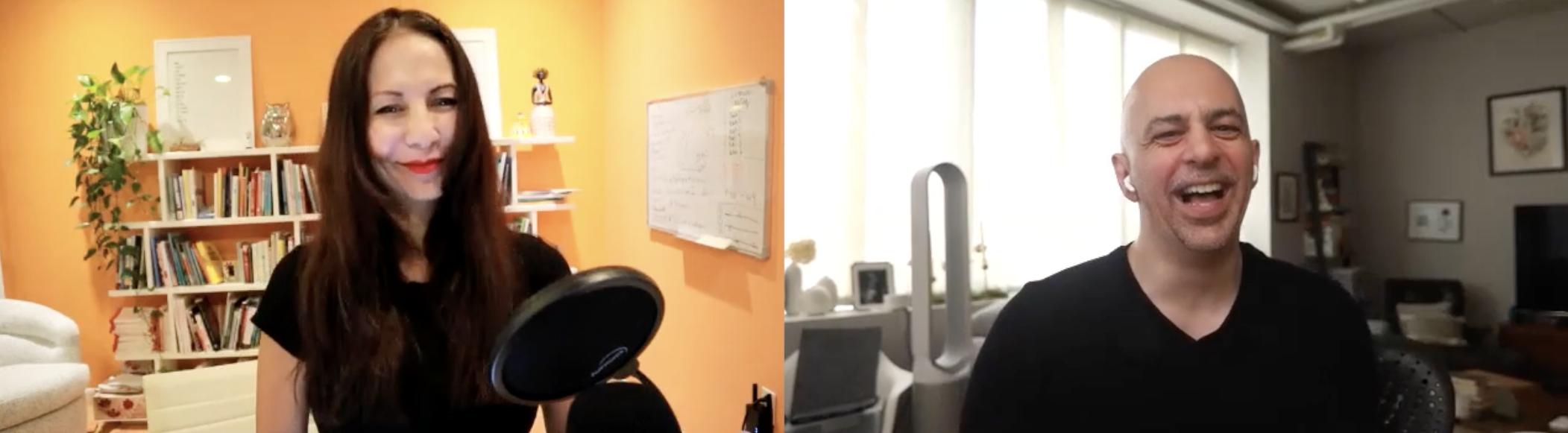
I am sharing today an interview with Espree Devora. Espree has been recently featured in INC Magazine as one of the top 30 women in tech to follow and is known as “The Girl Who Gets it Done.

In this conversation, we chat about how Espree manages stress being the caring person she is, how she manages stress given her work ethic, and how she manages stress in general as an entrepreneur.

Key Takeaways

  • How to find your own rhythms to navigate stressful moments
  • How to get things done without losing yourself
  • How to keep yourself accountable without being harsh with one’s self
  • How to practice distress tolerance skills on-the-go

About Espree Devora

Espree uses technology and digital content to thoughtfully connect people in the tech industry and move them from online connections to meaningful offline relationships. Her company, WeAreLATech, creates high quality digital content including podcasts, technology, and curated offline experiences focused on the Los Angeles tech and global women in tech ecosystems. These resources help the community accelerate in business via authentically connecting.

stress management

Resources

From Dr. Z’s desk

Listen Here

Apple
Spotify

The upsides and downsides of perfectionism (part 1)

The upsides and downsides of perfectionism (part 1)

There is nothing wrong with striving to do things right and perfectly. It depends on how often you do it, when you do it, and how it works in your life in the long run.

But, what is problematic is, demanding perfectionism, which involves demanding that you are perfect and do things perfectly, otherwise, you may think of yourself as unworthy, not good enough, or a screw-up.

Those particular patterns of perfectionistic actions can generate much anxiety, depression, loneliness, and insurmountable levels of stress, even when it feels good to do things right and perfectly in the moment.

Andrew Nalband is the Chief Executive Officer at Thunk Notes, a tool for thinking and journaling.

In this conversation, Andrew genuinely and kindly shares his struggles with perfectionism, and how he skillfully manages them these days.

Key Takeaways

About Andrew Nalband

He is a veteran of three classes of Techstars and the former Director of User Experience at Ubersense Inc. (acquired by Hudl in August 2014). Naval has helped more than 25 companies improve their products, and has driven iPhone apps to the top of the App Store and millions of installs.

perfectionism

Resources

Resources from Dr. Z

Show notes with time-stamps

01:00 Tackling Perfectionism
02:34 Deep Dive into Perfectionism with Andrew Nalband
17:18 The Benefits and Challenges of High Achieving Behaviors
32:59 Embracing Mindfulness and Letting Go of Perfection
 

Listen Here

Apple
Spotify

How to handle unhelpful perfectionism with Dr. Z and Clarissa Ong, Ph.D.

How to handle unhelpful perfectionism with Dr. Z and Clarissa Ong, Ph.D.

Are you an overachiever?

Some perfectionistic traits – e.g., being hardworking or paying attention to details – can be extremely handy. But what happens when you don’t do things in moderation and feel compelled to do more and more, do everything right, and avoid mistakes?

In this episode, I chat with Clarissa Ong, Ph.D., about her work on perfectionism.

Key Takeaways

We discussed in detail:

  • The coherence trap
  • Meta-awareness: awareness about awareness
  • Exposure exercises as awareness exercises
  • Motivational flexibility
  • Uncertainty workouts
  • Self-compassion practices

About Clarissa Ong, Ph.D.

Dr. Ong (she/her) is an Assistant Professor and the Psychology Clinic Director at the University of Toledo. She completed her Ph.D. in Clinical/Counseling Psychology at Utah State University, her predoctoral clinical internship at McLean Hospital/Harvard Medical School, and her postdoctoral training at the Center for Anxiety and Related Disorders at Boston University and CBTeam. Her research focuses on developing, evaluating, and disseminating effective interventions guided by behavioral and process-based principles.

perfectionism
Are Perfectionistic Actions Working For You or Against You?

Are Perfectionistic Actions Working For You or Against You?

  • Do you deeply care about what you do that you don’t measure what it takes you to accomplish a goal?
  • Are you a very conscientious person that struggles to do things that you are not-good-enough?
  • Are you super-committed to the projects you participate in that you forget to eat, sleep, or hang out with your friends at times?
  • Are you often preoccupied with thoughts about “I must do well, otherwise I’m bad?”
  • Are grit and discipline hurting you?

Perfectionistic actions can keep you in a “perfect trap,” but it doesn’t have to be all bad.

There are three important questions for you to answer to figure out whether your perfectionistic actions are working for you or against you.

Key Takeaways

In this episode, you will listen to a chapter from The Upside of Perfectionism: An Acceptance and Commitment Skills Audiobook.

You can learn Acceptance and Commitment Skills to release the shackles of perfectionistic actions without losing yourself and its benefits.

Listen Here

Apple
Spotify

ACT Focused Coaching

If you have specific questions about perfectionistic actions, have been dealing with them for a long time, and want to take things a step further, you can get 1:1 coaching to unpack those specific sticky moments.

In coaching sessions, I’ll provide you with:

Get the ACT AUDIOBOOK & COACHING here: https://bit.ly/3QlagBk

Sitting with uncomfortable emotions if you don’t overthink

Sitting with uncomfortable emotions if you don’t overthink

Reading Time: 3 minutes

If you subtract overthinking for hours, what are you left with?

      • Uncomfortable emotions.
      • And a mind attempting to make sense of those feelings (I’m using emotions and feelings interchangeably).

And as much as there are hundreds of messages to fix our emotions, to understand them, to make sense of them. There are emotions to feel and there are emotions to be tossed. But to make the distinction, when dealing with overthinking rabbit holes, you need to check what are the thoughts about emotions your mind is holding onto.

I feel it; therefore, it’s true.

We all struggle to distinguish what’s happening in a moment from what our mind tells us is happening; it’s as if the feeling of the moment dictates reality. For example, if I’m taking an elevator and have shortness of breath, my mind could anticipate that being in the elevator is unsafe, that I may have a panic attack, that I may need to avoid taking elevators in the future. And just like that, he decides to avoid taking an elevator because of all those reasons my mind is giving me. It’s as if because I feel something, is true.

My uncomfortable feelings will last forever

As uncomfortable as feelings can be, they do have a life of their own: they usually last for seconds and dissipate one after another. When emotions are left alone, on average they may last 90-seconds, including the uncomfortable ones.

It’s always good to think about my feelings 

If you have watched the movie Inside Out, you may agree that every emotion is trying to convey something to us, including the uncomfortable ones. But identifying what an emotion is trying to communicate to us is very different than mulling over the emotion over and over (as I do when complaining about the water company I have to deal with).  Dwelling endlessly on our feelings can actually amplify the intensity and duration of them and that applies to all feelings.

I feel it, therefore I need to act on it

We feel what we feel, and our mind instantaneously comes up with thoughts about what to do in that situation. It is as if whatever we feel means that we have to act on. Think about this: if you’re driving in your car, you hear about a new type of virus, and if you’re prone to overthinking, then naturally, your mind will come up with what-if thoughts. Along those what-if-thoughts, you may notice your teeth clenching, your face flashing .. and then quickly your mind will push you to rehearse all different ways to handle that possibility of having that virus .. and then you’re worrying for hours in your head, attempting to solve a hypothesis. What a waste of energy!

Having a feeling doesn’t mean acting on the feeling

It’s natural to overthink and sometimes it’s necessary, but when overthinking has its own journey and takes you away from being present in your life then it’s acting as a form of avoidance. As a form of protecting yourself from sitting with those uncomfortable feelings and all the thoughts, your mind comes to about the feelings and that particular situation.

No matter how terrible the emotion is, it’s the way you think about it, that prolongs it for looooooooooong periods and if you act on those feelings, then you keep prolonging those uncomfortable emotions. Thinking about the situation over and over, dwelling on it, getting upset at us for being upset at a situation, trying to come up with a positive emotion right away, etc .. and any other thinking strategy just makes things worse for you.

As much as we would like to control our feelings, especially the uncomfortable ones, we don’t have control of them; we only have control of our behavioral responses to a given feeling.

We just don’t have control of what we feel, we feel what we feel.

And you can handle that.


Navigating your way through creative perfectionism

Navigating your way through creative perfectionism

“You can fail at what you don’t want, so you might as well take a chance on doing what you love.”

– Jim Carrey

One way in which we play-it-safe is by delaying projects, avoiding important tasks or striving for perfection.

​​My guest today is Janis Ozolins, a visual illustrator.

Key Takeaways

In this episode, Janis and I focus on the creative process and perfectionism: what is it? Is perfectionism a bad thing? Is perfectionism an angel? Is striving for perfection a toxic trait? Is it both?

How do we do our best work while navigating self-doubt, criticizing thoughts, and a push to do things right and perfectly?

This conversation isn’t a conversation about productivity per se, but it’s a conversation about how we can be our best creative selves while navigating internal conflicts.

Janis shares how he handles self-doubtful thoughts, perfectionist tendencies, and negative feedback when sharing his illustrations.

You will also hear what drives Janis’s visual work and principles – or constraints – as he calls them – to create his visuals.

perfectionism

Resources

Resources from Dr. Z.

Show notes with time-stamps

00:00 The Perfectionist Monster
00:27 The Origin of the Perfectionist Monster Concept
02:15 Managing Perfectionism in Creative Work
03:40 The Power of External Accountability and Consistency
05:12 Embracing Imperfection and Learning from Experience
08:51 Creating Content with Purpose and Quality
13:18 Balancing Pride and Productivity in Creative Output
16:50 Exploring Creative Constraints and Process
19:40 Unveiling the Creative Process: From Inspiration to Illustration
20:56 The Art of Content Creation: Ideation to Publication
22:52 Evaluating Creative Work: Clarity, Amplification, and Impact
29:49 Navigating Feedback: Embracing Positivity and Dealing with Negativity
34:09 Personal Growth Through Self-Development Books
36:45 Dream Coffee Dates: From Historical Figures to Personal Connections
 

Listen Here

Apple
Spotify

HOW DO YOU PLAY-IT-SAFE?


Complete this 7-minutes quiz
and get your Playing-it-safe Profile!!

You have Successfully Subscribed!