Come back to the life you’re missing

Come back to the life you’re missing

Reading Time: 3 minutes

“How we spend our time is how we spend our days. How we spend our days is how our life goes. How our life goes determines whether we thought it was worth living.”

– Keith Yamashita

When you wake up, your mind starts its own journey. It’s like you’re getting into a car and your mind is the driver. Sometimes it takes you exactly to your destination. Sometimes it drives really fast. Sometimes, you can’t just get out of being lost in the streets of big houses, condominiums, and golf courses in the middle of the city. Sometimes, your mind takes you to the end of a cul-de-sac where you feel all those ruminations, worries, doubts, anticipations and many other acrobatic thinking patterns that occupy your time.

  • Thinking about doing things right and perfectly
  • Thinking about all the good reasons to postpone and delay stuff
  • Thinking about how much certainty you need to move forward
  • Thinking about the worst-case scenarios
  • Thinking about past negative outcomes or past mistakes
  • Thinking about not being good enough in some way
  • Thinking about the different ways to get out of a stressful situation
  • Thinking about how you’re the only responsible person for others’ wellbeing
  • Thinking about how thinking is fundamentally important

Overthinking patterns have this automatic quality, rushing you into feelings of stress, anxiety, loss, or dread. You may get so attached to them that they seem real and push you to do things that create much more pain, such as ejecting you from your present.

Dealing with overthinking partners is like every moment you’re confronted by a “haystack-sized pile of needles.”  Each one of those patterns pushes for your attention, makes you feel in a particular way, and claims to be legitimate. They are all interesting thoughts to have; for example, did I marry the right person? Can’t stop thinking about what happened before, I need to make sense of it; what if I don’t make the right decision? 

But the consequence of all of them is that they take you away from what’s happening in front of you, who is in front of you, and what the experience of that moment is for you.

Bring yourself back to the present

  • Acknowledge the cue to overthink
    Remember an important principle: The first thought on your mind, whatever you do afterward is on you.
    Do your best to notice that cue for overthinking (e.g. did I.. I need.. what-if…).
    Don’t fight it; don’t resist it; don’t respond to it. Just say to yourself “here it is.. “ and then …
  • Connect with your body
    Notice your body posture; notice the positions of your legs; notice your back posture; notice the ebb and flow of your breathing; you can also move your arms a bit to notice their movement.
  • Connect with what’s in front of you
    Notice your surroundings: what’s around you. What do you hear? What do you see? What do you smell?
    Notice who is in front of you: is there someone in front, next to, or behind you? How do they look? What colors are they wearing? What pieces of clothing do you see? How are they talking to you? Are they speaking fast or slow? Can you see the movement of their lips?

Final quote

I leave you with this last quote:

“How we spend our day is, of course, how we spend our lives.

– Annie Dillard

Watching your mind and its minding

Watching your mind and its minding

Reading Time: 4 minutes

Here is the deal about our thoughts:

  • Our thoughts about life are not life.
  • Our thoughts about life are descriptions of life

Here is the deal about our mind: Our mind is a maker of thoughts, a connector of thoughts, and a creator of patterns. And it’s default mode is to protect, defend and guide us from anything that could be a threat. Not our fault; that’s just what the mind us and that’s just how it kept us alive for hundreds of years.

Thinking is always in the background ….sometimes loudly, sometimes like a whisper, sometimes like a soft soundtrack.

Our thoughts come in the form of hypotheses, dreams, theories, stories, pictures, questions, calculations, or plans. Our thoughts also come with poignant doubts, criticisms, scary images, unpleasant possibilities, or distressing urges to find the right response.  And, when facing upsetting moments, all that thinking – all those thoughts – gets amplified, exacerbated, and augmented.

e.g. what if I lose my job; what if people make fun of me; would I make it? Did I research every option before making a decision?  

Thinking is always there.
Thinking is always happening.
Negative thinking is always popping up.

At first glance, the problem is with negative thinking itself. The problem with this frame is that it characterizes our mind as this omnipotent device that holds the truth, is accurate, and is always right. But, that ignores something crucial: the mind is always doing its own minding, regardless of what’s really happening inside and outside of us.

Take a look by yourself: set a timer for 2 minutes and watch what your mind does. Where does your mind take you? What words, letters or pictures does your mind come up with?

The problem is not with negative thinking itself; the problem is with how serious we take our thinking; how infatuated we are with thinking and how we rely on thinking to control what’s out of our control.

Think about it:

When having a doubtful thought (e.g. is this the right length of this article?),  we respond to that thought with other thoughts (e.g. I have seen other authors writing this length; what if it’s not; did I see things right? My friend Jess wrote around the same length; what if nobody reads this article? What if I’m writing for nothing? I’m not a writer…)

It’s like thinking gives us a sense of control of that uncomfortable experience – of that uncomfortable doubtful thought.

The late Harvard psychologist Daniel Wegner is well known for his work on thought control. When asked the question, “How do people control their own minds?” he responded:

“The simple strategy of directing attention can often be helpful, as people can stop thoughts, concentrate, improve their moods, relax, fall asleep, and otherwise control their mental states just by trying to direct their thoughts. These strategies of mental control can sometimes backfire, however, producing not only the failure of control but the very mental states we are trying to avoid.”

Wegner’s studies on thought control emerged from his research on thought suppression. Wagner illustrated what thought control is inspired by a line from Dostoyevsky: “Try to pose for yourself this task: not to think of a polar bear, and you will see that the cursed thing will come to mind every minute.” Wegner wrote:

People who are prompted to try not to think about a white bear while they are thinking out loud will tend to mention it about once a minute… It seems that many of us are drawn into what seems a simple task, to stop a thought, when we want to stop thinking of something because it is frightening, disgusting, odd, inconvenient, or just annoying. And when we succumb to that initial impulse to stop, the snowballing begins. We try and fail, and try again, and find that the thought is ever more insistent for all our trying. [2]

Our attempts to control our thoughts make sense; we may even feel less afraid, less at the mercy of what we don’t have control of. But then, we end up with a war of thoughts, one after another; one thought fighting against the other thought. We spend so much time proving, disproving, discounting and trying to make those uncomfortable thoughts stop.

It feels like when dealing with negative, repetitive, and distressing thinking our role is to surrender to it, to respond to thinking with more thinking, and to dwell and dwell.

But, that’s not true.

What type of relationship do you have with your mind?

That’s the fundamental question for you right now. 

  • Are you at the mercy of your thoughts?
  • Do you respond to thinking with more thinking?
  • Do you spend hours in your head trying to control what you cannot control in your outside world?
  • Do you respond with more thinking to all those negative thoughts your mind comes up with?

If you answer yes to any of the above questions, my friend, watch out!

As much as we need thinking to live our lives, it also can take us on a very dark path.

Instead of taking the thought making of your mind as your boss, what about …

Nurturing the relationship with your mind.

You can sharpen your thinking by nurturing the relationship with your mind.

Here is how you can nurture the relationship with thinking:

  • Radically accept that thinking happens, thinking comes and goes.
  • Turn your attention away from the thoughts that are not helpful to you in a given moment.
  • Keep in mind that your mind is always trying to protect you and it does it in the only way it knows: connecting thoughts, creating patterns, and coming up with a lot of thoughts.
  • Remember that when feeling anxious, scared, or distressed, your mind will quickly come up with all types of thoughts to protect you
  • Take ownership of your responses to thinking.
  • Even when your mind comes up with doubts, what-if thoughts, criticizing thoughts, ask yourself, would something helpful come for me if I respond to that thought? If the answer is not, refocus your attention.

I’ll expand these ideas in other articles. I leave with my last thought:

The first distressing thought is on your mind, the rest of the thoughts is on you.


How to deal with financial anxiety

How to deal with financial anxiety

Are you worried about making poor financial decisions?

Have you ever felt ashamed of your finances?

How do you relate to money?

Financial anxiety is real for most of us.

Quite often we do play-it-safe by avoiding financial decisions, predicting gloom and doom scenarios about potential decisions or we get paralyzed with what-if financial scenarios.

So, I’m excited to share with you a conversation I had with Amanda Clayman, a trained clinician specializing in money issues.

Key Takeaways

In this interview, you will hear:

  • Amanda’s stuckness with money
  • How Amanda creates a context to make values-based decisions about money
  • How you can relate to money as a way to expand your life (instead of contracting it)
  • How you can handle the shame, anxiety, and fears that come when making financial decisions

This conversation was very refreshing and hope you find it useful.

financial anxiety

Resources:

Show notes with time-stamps

03:11 Amanda’s Personal Journey with Money
03:38 The Shift to Financial Wellness Coaching
09:30 Understanding and Managing Financial Anxiety
16:15 Embracing Values-Based Financial Decisions
25:02 Navigating Financial Decisions and Uncertainty
 

Listen Here

Apple
Spotify

Types of overthinking

Types of overthinking

Reading Time: 3 minutes

Like ice-cream, there are so many types of overthinking. 

Given the busyness of our minds and the unavoidable stream of thoughts we all have every moment we’re awake, it’s natural that each one of those thoughts could unfold into a thinking pattern.

You can have a thinking pattern about your morning routine, how to read a book, ask for a raise, and so on. Similarly, when facing an upsetting or anxiety provoking situation, of course, your mind is going to come up with a thinking pattern about how to manage, handle, and take care of what’s stressing you out.

The more that you rely on those thinking patterns, the more they get reinforced, get established, and get generalized to similar situations:

Here is the deal:

There are an alarming number of major life decisions we need to make: who we choose to marry, the school we go to, the house we want to buy, the next job you need to apply to, a relationship you need to get out from, the location where you want to retire, the amount of money you need to retire, and so on. Each one of those decisions requires careful thinking, for sure.

Simultaneously, there are day-to-day decisions, banal ones that we also get stuck on at times: the size of the TV you are going to buy, the coffee machine you need to get for your office, the model of the cell phone you’re going to get, how you spend your time, which task to focus on first given the laundry list of things you have to take care of,  the type of laptop you need for creating videos, the destination of your next vacation, the veterinarian for your pet, the book you’re going to read to your children. And so on.

Whether you’re making a major life decision or day-to-day one, all of them can be anxiety provoking. Naturally, as all humans do, you think of that particular situation as an attempt to solve it and with that, to solve your discomfort, struggle, uncertainty, and stress with it.

It’s all that thinking you do that evolves into overthinking patterns that, paradoxically, instead of moving you forward, it keeps you stuck in your head in the long run. It’s like overthinking is a safety move.

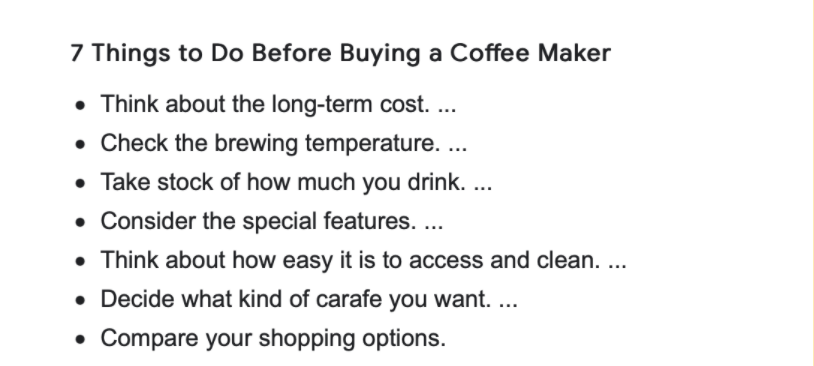
When completing my internship, with limited financial resources as a grad student, I decided to treat myself with a coffee machine. I love to drink a good cup of coffee! I looked at my budget and I could afford a coffee machine between $80 – 100.- max. The search began. Google recommend me to keep in mind these variables:

2021 11 18 17 10 32 1

My friend, a coffee snob like myself, encouraged me to consider “strength and flavor” as important qualities for this new acquisition.

In my relentless efforts to make the best decision for what a coffee machine represents to me, the amount of money, and all those variables that appear to be important, I spent 3 months dwelling on this decision. Until finally, fed up with this overthinking, I drove myself to a store and bought “a coffee machine.”

Overthinking is when thinking gets in your way of living your life.

Here are the types of overthinking patterns that you need to watch out for:

  1. Thinking about doing things right and perfectly
  2. Thinking about all the good reasons to postpone and delay stuff
  3. Thinking about how much certainty you need to move forward
  4. Thinking about the worst-case scenarios
  5. Thinking about past negative outcomes or past mistakes
  6. Thinking about not being good enough in some way
  7. Thinking about the different ways to get out of a stressful situation
  8. Thinking about how you’re the only responsible person for others’ wellbeing & important situations
  9. Thinking about how thinking is fundamentally important

While thinking carefully is an integral part of our lives, it also eject us from the present and rob us of fulfillment.

How to relate to anxious thoughts when performing competitive sports

How to relate to anxious thoughts when performing competitive sports

How do the top athletes think about their physical struggles – pain, exhaustion, thirst – when competing?

How do the top athletes push their bodies to the absolute limit over hours or days of competition?


When feeling under significant pressure or in high stakes situations, it’s natural that our mind jumps to conclusions about what’s going on or what’s going to happen.

It’s natural that our mind comes up with thinking traps. It’s natural that our mind compares our performance with others’ performance. It’s natural that our mind pushes us to stop trying, to give up, and to stop competing.

I had the honor of interviewing Alex Hutchinson, a journalist, former Canadian national team distance runner, current award-winning science journalist, and author of the book Endure.

Key Takeaways

In this conversation Alex kindly shares:

  • His writing process
  • How he decided to write Endure
  • How he maintains a scientific approach to his writing
  • How he handles the uncertainty of not knowing
  • How to think about physical sensations during a high athletic performance
  • How to relate to physical discomfort when competing at a professional level

This conversation has reminded me, once again, about the importance of scientific humbleness.

anxious thoughts

Resources:

Show notes with time-stamps

01:33 Newsletter: A Deep Dive into Acceptance and Commitment Skills
03:01 Today’s Special Guest: Alex Hutchinson, PhD
04:18 Exploring the Mind-Body Connection in Athletic Performance
06:08 Behind the Scenes of Alex Hutchinson’s Writing Process
14:35 The Scientific Approach to Contradictory Research
24:34 Navigating Criticism and the Challenges of Scientific Journalism
28:16 The Journey of Writing ‘Endure’: From Idea to Publication
33:14 The Writing Process: Balancing Journalism and Book Writing
39:17 Unlocking the Writer’s Block: A Personal Strategy
39:58 The Outline Dilemma: Sticking to the Plan vs. Flexibility
41:04 The Two Schools of Writers: Perfecting the First Sentence
42:16 Exploring Athletic Performance: Mindset, Muscle, and Limits
43:03 The Power of Acceptance in Enhancing Performance
43:29 Self-Talk, Brain Training, and Performance: An In-depth Look
49:55 Navigating Negative Thoughts and the Role of Acceptance
01:00:08 Visualizing Success: The Right Way to Prepare
01:07:41 Personal Reflections on Belief and Performance Limits
01:11:57 A Dream Conversation: Tea with a Marathon Legend
 

Listen Here

Apple
Spotify

Why do we overthink?

Why do we overthink?

Reading Time: 5 minutes

“Y ou can spend minutes, hours, days, weeks, or even months over-analyzing a situation; trying to put the pieces together, justifying what could’ve or would’ve happened… Or you can just leave the pieces on the floor and move the fuck on.”

– Tupac Shakur

Busy Minds

Whether you’re awake or asleep, your minds is constantly thinking in soooooooo maaaaaaaaanyyyyyyy waaaaays. Your mind is constantly problem-solving, planning, reasoning, justifying, dreaming, and on and on. Your mind is hardwired to come up with long streams of thoughts – including pictures, images, memories – that range from fascinating and innovative to irrelevant and dark matters.  Your mind tends to think deeply about the stuff you care about. All this to say that, we all have very busy minds that are constantly thinking and thinking.

Here is how thinking may look at times:

  • Natasha: I can’t stop thinking about what happened before
  • Peter: I got completely lost in my thoughts
  • Sylvia: I’m calculating the possibilities of this particular outcome, so I know what I’m getting into
  • Sam: It’s in my nature to visualize all the things that could go wrong
  • Maggie: What if I’m a failure?
  • Alak: I get soooo carried away by my thoughts
  • Richard: I need to get this order in the right way, otherwise …
  • Russ:  I keep replaying in my mind over and over how I made a fool of myself
  • Tito: I need to know for sure, so I can make a good decision

There is nothing wrong with thinking, of course, we all do it and my goodness, we do so. But, when it comes to thinking, no skill is more valuable than learning to check how our thinking is working. 

Here is the deal: When faced with stressful, unknown, and anxiety-provoking situations our brains tend to rely on many mental shortcuts, overthinking is one of them. 

As a full-time psychologist and full-time human being, I have witnessed and experienced firsthand how overthinking can trick us, so easily, so quickly, and so brutally. It’s like without realizing – most of the time –  left to our minds, we can spend hours and hours in our head while the clock keeps making the tick-tock sound, the screen looks blank, and we haven’t done anything.

How can you move on with your day when your mind is racing? How can you watch a movie when you feel anxious and your mind is going on and on? How can you be present with your friend when your mind is coming up with over seven thousand thoughts a day?

I’m not a thinking renegade, but I’m all about a thinking revolution so you can learn how to relate to thinking in a skillful, effective, and compassionate way.

What is overthinking?

Overthinking is like listening to the new song of Cold Play, “You’re my Universe ” in the background, persistently, and repetitively more than what you want and need. 

Overthinking is when your mind spins on a thought, picture, or idea for a much loooooonger time than is needed. 

Overthinking is a way in which our minds are trying to optimize our thoughts, but left unchecked, our thinking can get in our way of what we need to be doing, what we want to be doing, and doing what matters to us. 

In a few words,

“Overthinking is when thinking gets in your way of living your life.”

Why is it hard to stop overthinking?

Our ability to reflect, ponder and think critically and carefully about things – including ourselves – is one of our greatest tools. But like any tool, it can be used effectively or ineffectively; it can be used in our favor or against us. And when it comes to overthinking, unfortunately, because we all have been trained to rely on thinking for everything, to think critically, and to respond to thinking with more thinking, which makes it trickier.

To stop in the rabbit hole of over-thinking, you need to learn to step back and distinguish when thinking and overthinking is getting in your way of doing what you care about and being who you want to be; and when it’s taking you closer and closer to living your goals, dreams, and values.

Why do you overthink? 

Here is an interesting reality about overthinking that may be hard to digest: overthinking is a form of avoidance.

Let’s say that you’re considering taking a trip during the weekdays. As fall transitions into autumn, the days grow shorter and darkness extends, you pause; take a sip a glass of water, imagine walking in the colorful streets of Todos Santos, Mexico, feeling the warmth of the sun on your face, hearing words in Spanish that you’re unfamiliar with, and yet, that’s what you want. Then, abruptly, your mind comes up with what-if thoughts: “What if my partner, friends, and family think that I don’t work hard enough, that I’m not committed to my job, that I have poor work ethics, that I’m not being financially responsible, that I don’t care about my co-worker’s needs, that I’m self-focused … what – if .. what – if …

As the what-if thoughts become present in your mind, one after another .. your shoulders tense, you try to shift your neck from one side to another, and yet, your mind keeps doing its own thing. You’re faced with the decision of whether to continue engaging in the possibility of traveling to Todos Santos or continue working so nobody holds a negative impression of you.

What could happen if you get a ticket to Todos Santos, book a hotel, jump on a plane, and let yourself enjoy that mini-vacation? If you do so, that means making room for the fun, exciting, and joyful moments of this adventure and also the fears, worries, and concerns about being misperceived as someone you don’t want to be.

Do you see how overthinking could be protecting you from feeling uncomfortable experiences?

  • The answer to overthinking problems is action.
  • The way to get out of your head is by doing.
  • The road to stopping dwelling is to approach.

Here is the one thing you can do right away to tackle those hours of overthinking

Think about a particular matter your mind is overly focused on and then ask yourself these questions:

  • How would you feel if you don’t overthink that particular topic?
  • Who are you without all that thinking and thinking?
  • How do you feel about yourself without spending hours in your head?
  • What is your mind trying to protect you from with that particular soundtrack playing over and over?

P.S. I’m working on a guide on “how to stop shitty thinking cycles” and would love your help. Could share with me – anonymous if you prefer – what type of thoughts do you overthink about. Click here to share those shitty thoughts that keep you stuck.

I hope to hear about all those overwhelming thoughts your mind comes up with insistently. I know, my mind is not the only one that wrestles for hours with thinking and thinking. 

HOW DO YOU PLAY-IT-SAFE?


Complete this 7-minutes quiz
and get your Playing-it-safe Profile!!

You have Successfully Subscribed!