About the book
Why Use a Single Treatment for All Emotional Problems?
For many years, psychotherapy researchers focused on developing specific treatments for each of the emotional disorders. There were individual treatments for the six anxiety disorders, several empirically tested treatments for depression, several for anger, as well as protocols for guilt and shame. All in all, researchers developed more than two dozen treatment regimens for emotional disorders.
This profusion of treatments had good and bad aspects. The good news was that psychological science had developed multiple research-based protocols that had been proven effective. They helped people and changed lives. The bad news can be summarized as follows:
(a) People with more than one emotional problem (called co-morbidity) had to undergo more than one treatment. Treatments were often done sequentially, so therapy for one problem might be delayed while another emotional problem was addressed first.
(b) Skills developed to cope with a particular emotional problem were often not generalizable to others. So, for example, a successful treatment for social anxiety in your 20’s wouldn’t give you the tools you needed to cope with depression in your 30s.
(c) Most of the protocols for emotional disorders were focused on symptoms and symptom reduction. They didn’t address the common underlying factors that create and maintain all emotional disorders. These are called transdiagnostic factors (TDFs). A treatment that targets TDFs—the cause of emotional problems—may be more effective than one that is merely focused on symptoms.
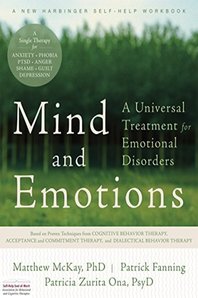
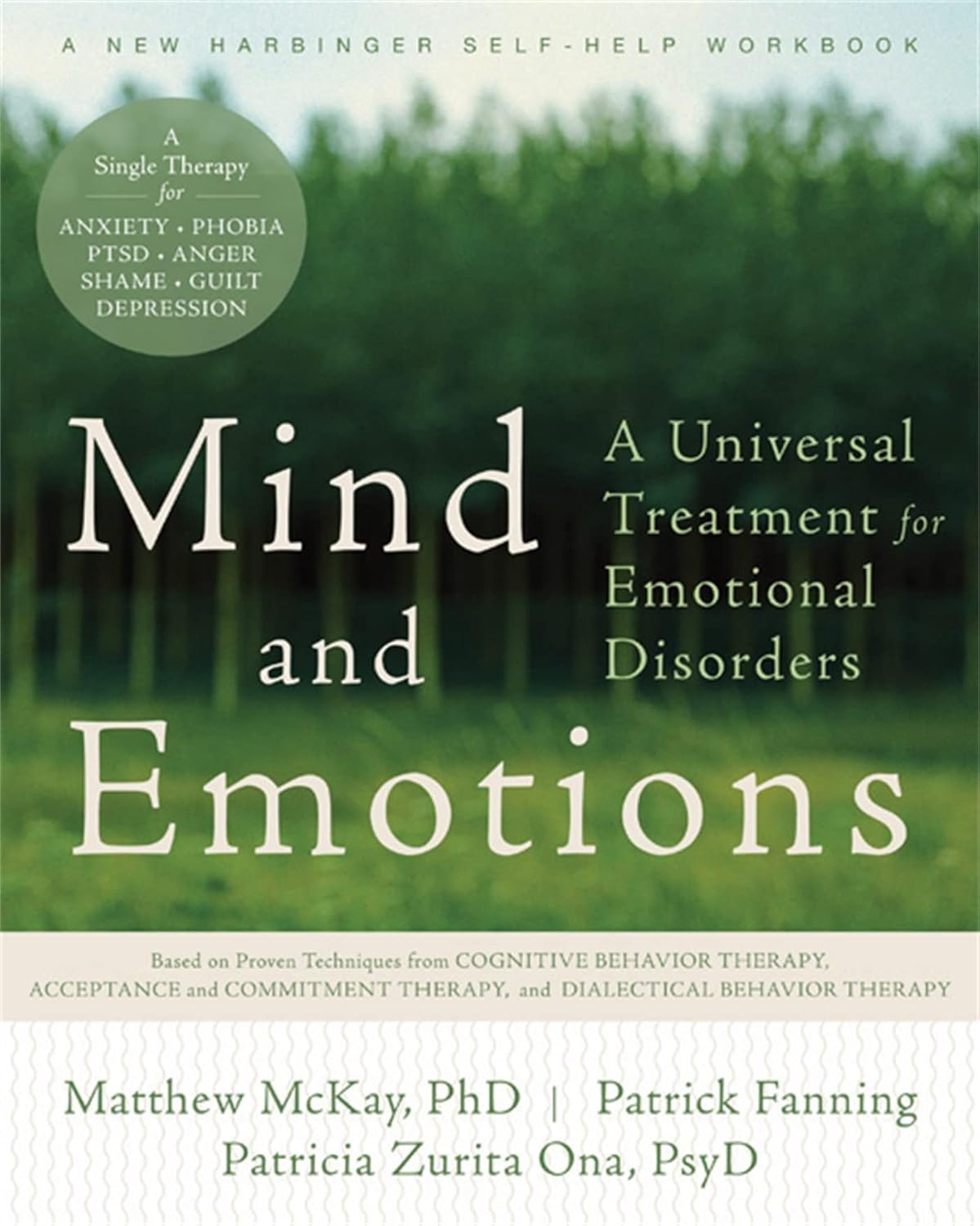
This book is a universal treatment protocol to help you with feelings of anxiety, depression, anger, shame, or guilt. It will also help if you are struggling with high levels of multiple emotions—called emotion regulation problems.
Reading isn’t enough to learn emotion regulation skills. They can only be mastered by doing the actual exercises in this book, and putting them into practice in daily life. The changes you seek with overwhelming emotions start with changes in your behavior—how you think and how you act. Altering your old is essential to creating a new life and a new relationship to your emotions.
We’ll be with you every step of the way: showing the path, coaching you, giving you examples of how others have succeeded. We’ll have answers to many of your questions, helpful strategies, and step-by-step guidance for how to get you there. Working this program iswork. We admit it. But if you do the work and change your old avoidance patterns, a lot of your emotional pain will fall away. It will just be a memory. The research-tested modules in this program can open the door to a new life. We encourage you to start now. Turn the page, walk through that door, begin the changes you’ve been yearning for.
You got this!

What’s inside
Chapter 1: The Universal Treatment
Chapter 2: The Nature of Emotions
Chapter 3: The Cost of Avoiding Emotions
Chapter 4: Values in Action
Chapter 5: Mindfulness and Emotion Awareness
Chapter 6: Defusion
Chapter 7: Cognitive Flexibility Training
Chapter 8: Self-Soothing
Chapter 9: Doing the Opposite
Chapter 10: Interpersonal Effectiveness
Chapters
Pages
About Dr. Z.

I’m originally from Bolivia, South America, and am a psychologist by training. I’m formally trained in empirically supported treatments, and when I say “formally,” I mean that since 2004 I have received intensive training in them, particularly in Acceptance and Commitment Therapy (ACT) and Cognitive Behavior Therapy (CBT).
Over the past 18 years, I have created resources for and worked with overthinkers and overachievers dealing with all types of fear--related struggles: perfectionism, procrastination, productivity anxiety, uncertainty intolerance, indecision, impostor phenomenon, overthinking, phobias, rumination, panic, worry and obsessive-compulsive disorder. I absolutely love my job!
In 2019, I was nominated as a fellow by the Association for Contextual Behavioral Science because of my contributions related to the applications of ACT for fear-based struggles. I’m the author of seven books and the co-author of three (see the section on previously written books).
I’m the founder and director of the East Bay Behavior Therapy Center, a boutique private center in the San Francisco Bay Area that offers therapy and coaching for anyone experiencing anxiety-based struggles.
In 2023, I gave a TEDx talk, “Stop playing-it-safe and start living” that has more than 264K downloads.
While I’m a psychologist by training and science-based by passion, my style is jargon-free, accessible, caring, and lighthearted; teaching ACT skills doesn’t have to be boring or inaccessible, so I do my best to make every skill I teach—in any format—as engaging as possible.
I believe that learning to navigate fear-based reactions is one of the key skills of the 21st century, and I’m passionate about it.
I'm passionate about disseminating ACT skills for anxiety-based struggles.



Other books